
In the developmental stage
POST FALLS – Once a month, while most folks are sipping morning coffee, the Post Falls Urban Renewal Agency holds a 7 a.m. meeting to go over six current construction projects within the city.
The projects are designed to create good jobs and boost the region’s economy, in partnership with private developers.
The agency’s role is to facilitate such developments. For the most part, the urban renewal group oversees installation of infrastructure on marginal lands, or districts, to attract future retail, industrial and other commercial ventures.
Behind the growling end-loaders and earth movers, the agency quietly handles the nuts and bolts of making sure that such aspects as quality sewer and water lines, street lights and curbs are installed.
“This agency ‘gets it,’ ” said Eric Keck, Post Falls city administrator. “It does a good job of looking at projects that make sense and ensure urban renewal. And it does so in a frugal manner.”
Since its creation in 1991, Post Falls Urban Renewal Agency has taken full advantage of its planning and spending authority.
“To our best count, 2,641 jobs have been created since the Post Falls Urban Renewal Districts opened,” said Luke Malek, the agency’s executive director.
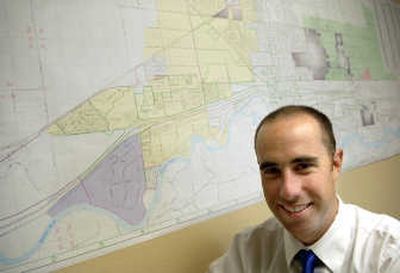
He’s directing the city’s active projects, which encompass a total of 1,800 acres throughout town. All are north of the Spokane River.
“Urban renewal is the only tool cities have to increase economic growth,” Malek said.
Buck Knives, Sysco Food Services, 84 Lumber and furniture maker flexcel have already been drawn to the sites.
Perhaps the most publicity has been showered on the much-awaited Cabela’s store, expected to open by Christmas. It will anchor The Pointe at Post Falls, within the Center Point urban renewal district.
A few weeks ago, the retailer began advertising in the area for new hires.
That’s not all. In the years to come, Post Falls is expected to draw even more commercial, retail, light industrial and manufacturing companies inside its boundaries – all thanks to its urban renewal agency.
Post Falls Mayor Clay Larkin and the City Council couldn’t be happier with the progress.
“Keep up the fine work you and your agency do,” Larkin told Len Crosby, the agency’s chairman, after he briefed the public on the latest developments.
Chartered by the state in 1965, urban renewal agencies won authority to stimulate economic growth within their respective municipalities, Malek said.
They received their most valuable tool – tax-increment financing – in 1985, another result of state legislation.
TIF districts, as they’re known, enable cities to temporarily use taxes for improving marginal properties – with the intent to pull developments to town.
Post Falls has led the way in creating, developing and closing the state’s first urban renewal agency project.
That project, along West Seltice, started in 1992 on 665 acres of former farmland in the north-central part of town.
Traffic signals, fire hydrants, landscaping and bike paths were installed. The improvements attracted flexcel to the site.
“We’re diligent about closing districts,” said Malek “We stick to our mission.”
Now, the West Seltice district’s market value has spiked by more than $55 million while creating 400 jobs, according to documents provided by the urban renewal agency.
In 2010, the last of the six current districts is expected to be paid off or closed.
When they do, the city expects to annually collect an additional $19 million in taxes for such entities as public schools, libraries, fire districts, emergency services, highways and North Idaho College.
“It’s crucial we have urban renewal for economic development in Post Falls,” Keck said. “This agency is very committed to seeing its role as integral to the growth of the city. And it doesn’t belabor a district’s life, therefore depriving other entities of tax growth,” Keck said.