
Landmarks: Ancient symbol is mark of Greek god Hermes
Reader Lee Zimmer brings a curious fact to this columnist’s attention.
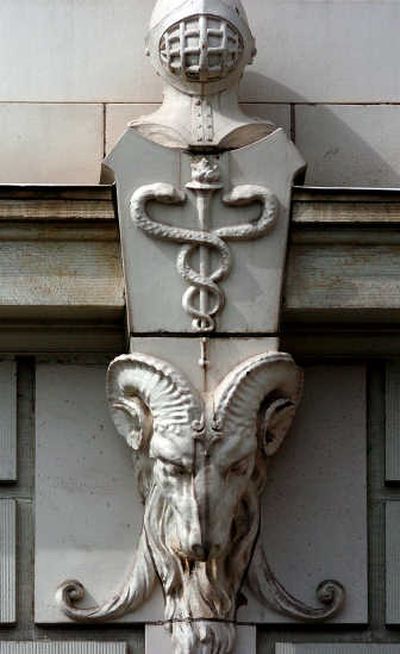
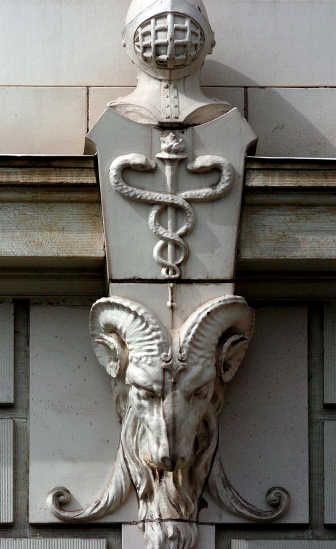
The exteriors of several buildings in Spokane have what most of us consider to be a medical symbol – the caduceus, a winged staff with two entwining snakes. But these buildings have nothing to do with healthcare.
Among the buildings Zimmer pointed out are the Davenport Hotel and the downtown post office.
Sure enough, there’s the caduceus on the post office – used three times above the tall windows about two-thirds of the way up the front of the building.
And on the elegant, historic Davenport Hotel in downtown Spokane, the caduceus is repeated along the cornice between the second and third floors on the north, west and south sides of the building.
What’s the story behind these uses of the caduceus?
First, a clarification. The caduceus isn’t really the “official” symbol of the medical profession.
That honor belongs to the Rod of Asclepius, a single serpent wrapped around a staff (with no wings). An ancient Greek symbol associated with healing the sick, it is named for Apollo’s son, Asclepius, a physician. It is used today as part of the logo of the American Medical Association.
However, it often is confused with the caduceus. To muddy the waters further, the U.S. Army Medical Corps and U.S. Naval Hospital Corps adopted the caduceus as their official emblem. (Even when the error was noted, the emblem was not changed.)
In ancient Greece, the caduceus was associated with Hermes, messenger for the gods and protector of those involved with commerce, invention, travel, eloquence and theivery.
It is used as an emblem by merchants, journalists and postal workers. It also has been used as a printer’s mark, but when seen in medical texts, it is mistaken as the medical symbol.
Postal workers have adopted the caduceus throughout history due to its association with Hermes the messenger, which explains its presence on Spokane’s downtown post office.
However, its usage on the Davenport Hotel is another story, detailed in the 1915 publication, “Pride of an Empire,” which chronicles the creative forces behind the development of Louis Davenport’s hotel.
In discussing the iconography within and on the exterior of the hotel, the publication speaks of the grouping of the caduceus with a helmet and ram’s head in bold relief on the exterior of the building.
The closed helmet is suggestive of protection, and in classical symbolism, the ram’s head represents push and determination, said Tom McArthur, communications director for the Davenport Hotel. With the helmet above and the ram’s head below, the caduceus overtops these on the keystones breaking the lines of the cornice.
This is intended, according to “Pride of an Empire,” to “bring to mind the mythological tale of how Hermes or Mercury, the patron of commerce and travel and whatnot, coming one time upon two serpents apparently bent upon annihilating each other, threw between them his staff, whereupon, we are told, they entwined about it, and themselves, and continued ever after to exist in friendly rivalry.”
The book’s account continues, rather grandly: “Does this detail in particular symbolize all that is best in honorable, decent competition? Is it not markedly suggestive of that energetic, yet friendly quest of trade which has characterized the industrial history of the Northwest and made possible that prosperity and advancement which has become the wonder of the world?”