
‘Trash the dress’ photo shoot targets keepsake

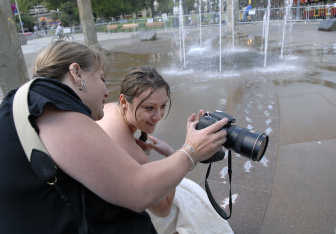
Everything was perfect. Her makeup was flawless. Her veil was flowing. Her white wedding dress, strapless, the lace glittering with beading, was elegant and beautiful. Not at all nervous, Lisa Underwood was ready to take the plunge.
With dozens of people gawking, she jumped into the columns of water shooting up from the Riverfront Park fountain. Today she and her $700 wedding dress had been through it all: at the back of a furniture warehouse, sliding down the Radio Flyer structure into the sand, and even sitting in bird poop under train tracks.
Married last month, Underwood, 21, was participating in a photo shoot called a “trash the dress” session. The idea, said photographer Lori Adalsteinsson, is to create high-fashion style photos in unlikely settings without worrying about the condition of the dress.
“It’s just running around and having fun without worry about the dress,” she said. “It’s not the goal to ruin the dress, but more about being real.”
Underwood isn’t the only bride attracting stares. Sessions have popped up all over the United States, many of them chronicled on a trash-the-dress blog, a site that has even inspired overseas photographers to start their own trash-the-dress sites in the United Kingdom and the Philippines.
Adalsteinsson said she has been doing similar sessions for years. She also applies the trash-the-dress concept to bridesmaid dresses and prom dresses.
“These gals spend all this money on these fancy dresses,” she said. “It always drove me nuts when people were afraid of getting them dirty.”
She’s scheduled to do sessions with another bride and three teenagers who want to model their prom dresses. A three-hour session starts at $599.
“There’s such a stigma with wedding dresses. Don’t step on the dress; don’t get dirt on the dress,” Adalsteinsson said.
At one point they end up underneath a railroad, staring at the trestles. Everything is covered in bird poop, including the trestle Adalsteinsson has Underwood climb up on. Underwood sits in a striking pose, exaggerating her angles like a model in a fashion magazine. There are cars going by around the island they are on. Countless drivers honk, whistle and yell out cat calls.
Underwood enjoyed being a model.
“I should wear a wedding dress every day,” she joked.
Earlier generations of brides may disagree. For them, the gown weighs heavy with tradition. The dress is only worn once in public before being sealed in a preservation box and entombed in an attic or closet for safe keeping.
Underwood’s mother-in-law told her it made her sick to her stomach when she found out what Underwood had planned for her wedding gown. But it didn’t deter her. She wanted to get the most out of her dress since she spent so much money on it.
“I wanted to do something worthwhile,” she said, adding that she didn’t want to just store it in her closet forever. “It’s better in a picture as artwork.”
It took Underwood two tries before she settled on that particular wedding dress. The first dress she ordered online. When it arrived in the mail the dress wasn’t what she had expected, so she ended up at Celestial Designs, where she finally found the right one. It was the dress she wore the day she married her high school sweetheart, Oliver.
Celestial Designs’ owner Erlene Clifton, who has been selling wedding dresses for seven years, has heard of the extreme versions of these sessions where brides actually try to damage the dress. She doesn’t think the trend has really caught on here, but she can’t imagine why anyone would want to do it. She can’t imagine how they could.
“Women attach feelings to these dresses,” she said. “Probably more than any other piece of clothing.”
Clifton has kept her dress since she was married 37 years ago. It wasn’t preserved properly, so it is yellowing, but she made it by hand and she’s going to continue to keep it.
Amber Thompson overheard Clifton’s comments on dress trashing and her eyes grew wide in disbelief.
“I would never do that,” she said.
Thompson and her husband, John Thompson, were in the store to visit the wedding consultant who had helped her with the dress she got married in last August.
“That’s your day. That’s your dress. That’s your day to be a princess,” she said. “My daddy cried when he saw me in my dress.”
Her dress is preserved, safely stored in a box. The day after John proposed, she found it at Celestial Designs, but she kept searching just in case.
“I went to every shop in town, just to make sure it was the one,” she said, laughing a little.
On their wedding day, the couple was careful not to get the white gown dirty.
“I wouldn’t let anyone get within two feet of her dress if they had anything in their hands,” said John. He doesn’t think these sessions can be justified as a modern trend.
“Times change, traditions change,” he recognized. “But keeping the dress, keeping some of the silverware … those traditions don’t change.”
For Underwood, the traditions aren’t set in stone. The dress can still be cleaned and kept, or she could do another session, this time with her husband.
“I’m glad I got to do it,” she said. “That was awesome.”
After the fountain, a shivering Underwood makes her way back to the car, water dripping from her arms as she carries her skirt, now bloated with water. Most of her makeup has washed off and her wet hair hangs limp. She’s smiling. In the car, she changes out of her dress and hands it to Adalsteinsson, who is surprised by the weight.
“Wow, feel how heavy that is,” the photographer said. She folded the dress up and tossed it into the back of her trunk, and the two women drove off to another spot.