
Elwha dams coming down
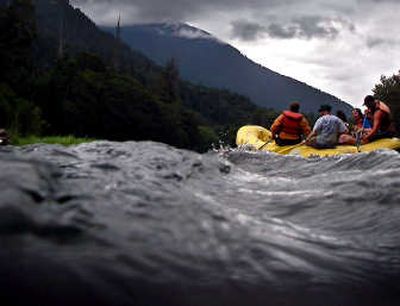
PORT ANGELES, Wash. – Floating down the Elwha River, Robert Elofson nodded his head in appreciation.
A trio of harlequin ducks skittered across the river’s tumbling surface as they took off. Downstream, a handful of mergansers quietly dozed, ignoring the three rafts drifting by their riverside roost.
Rings on the river’s surface marked the occasional rise of a trout as it slurped in a bug for a midday meal.
With the Elwha River already a remarkable outdoors experience for kayakers, rafters and anglers, Elofson believes it will become so much more when the two dams that impede its journey to the Strait of Juan de Fuca are removed.
He’s in a position to know. Now the river restoration director for the Lower Elwha Klallam Tribe, he has been involved in the effort to remove the Elwha and Glines Canyon dams since 1992.
Elofson was among a group, including Olympic National Park staff members and members of the National Park Conservation Association, on a recent afternoon float meant to show what the river could be like when the dams are removed and the lakes behind them drained.
When the river flows freely from its headwaters in the Olympic Mountains 45 miles to the strait, the focus will shift to restoring runs of 10 species of fish, including all five Pacific salmon stocks and steelhead.
But the impact will extend beyond the riverbanks.
Port Angeles will have a new water-treatment plant, eliminating the $1 million the city spends annually to protect its current plant. The contract for that project, estimated at $15 million to $25 million, could be awarded within the next week.
Another project, estimated at $60 million to $80 million, will improve flood protection and build an Elwha water-treatment plant. That contract should be awarded late this fall, said Brian Winter, project manager for the park.
Overall, the $185 million dams project could mean an estimated $96.8 million in business spending and 1,650 construction jobs, producing $51.5 million in personal income, according to projections.
Studies also predict increased recreational use, tourism and fishing will add $355 million to the local economy over the next 100 years.
Once the construction contracts are awarded, officials will have a better sense of when the dam removal will begin, Winter said. It’s scheduled to begin in 2009 and take two to three years.
“Right now we’re focusing on the water mitigation contracts,” Winter said. “Once we get those awarded and construction timetables set, we’ll reassess the dam removal timetable.”
When that happens, the river will flow freely as it once did almost 100 years ago.
The project is not without its risks.
Along a side channel sit several historic buildings at the Elwha ranger station.
“There are no plans to move the buildings,” said Pat Crain, a fisheries biologist for the park. “And armoring the bank with rocks runs counter to the intent to restore the natural environment.”
Also lost will be the recreational fisheries in Lake Adwell, behind the Elwha dam, and in Lake Mills, behind the Glines Canyon dam.
Yet if plans to restore salmon, steelhead and trout populations come to fruition, those lost fishing opportunities will be negligible.
Right now, 5,000 to 10,000 salmon return to the river. But the fish have just the lower five miles in which to spawn before reaching the Elwha Dam. Officials said 22 species of wildlife, including bald eagles, black bears and river otters, have declined because of a lack of salmon carcasses in the upper river.
Removing the dams will give fish access to more than 70 miles of habitat.
The goal, Elofson said, is to produce runs that reach 400,000 fish.
“I think it’s doable,” he said. “Eighty-seven percent of the drainage is in the park, so that habitat is protected.”
The state will concentrate on restoring chinook runs, while the tribe concentrates on coho, chum, pink salmon and steelhead. Fish eggs, fry and yearlings will be planted upstream to build new runs.
Restoring runs to such levels will take time, likely between 12 and 30 years, Elofson said.
“I’m hoping it will happen as fast as the Toutle (River) rebounded after Mount St. Helens erupted,” he said. “I’d just love it if it took just a couple of runs.”
As for when fishing – recreational and commercial – will be allowed, that’s another matter. Crain said the state and the tribe have agreed not to fish for the first five years after the dams come down.
“The primary objective is to restore the salmon runs to the Elwha,” Crain said. “Fishing will be secondary.”
Looking to the future, Crain cites the South Fork of the Skykomish River as an example. A fish passage was built around Sunset Falls, and now the watershed is a healthy ecosystem.
“In 10 to 15 years, I think we’ll see fish throughout the watershed,” Crain said, referring to the Elwha. “In 50 years, I think you’ll see something similar to what existed before the dams went in.”
As the group neared the takeout this past Thursday, Elofson said every dollar that has been spent, every meeting attended, every document written and reviewed, has been worth it.
“I wouldn’t want to tell my kids we had the chance to restore this river and we didn’t take it,” he said.