
The price of success
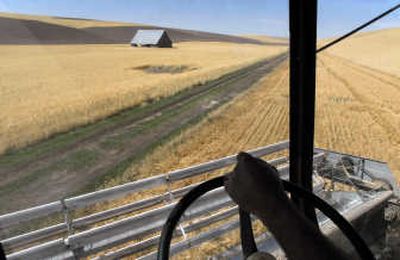
Farmers across Eastern Washington are keeping one eye on the paths of their combines as the huge machines cut valuable grain, and the other on federal legislation wending its way through Congress that they expect will sustain them if prices collapse.
Every five years Congress passes a Farm Bill, the most important federal law for agriculture. It’s expected to be a $40 billion heavyweight offering money for nutrition programs, including food stamps; conservation initiatives for farmers to return farm fields to wildlife habitat; and crop subsidies that guarantee farmers a paycheck for growing staples like corn, wheat, soybeans, rice and cotton.
The stakes are high for Washington state. The federal government has poured about $2.5 billion into the state’s agriculture from 1995 to 2005 – most of it going to wheat farms, led by those in the rich Palouse. The single largest recipient: not a farmer or agribusiness, but the Washington State Department of Natural Resources. The agency collected $11.4 million in equal parts conservation payments and crop subsidies during the decade, according to a comprehensive database kept by the Environmental Working Group.
The coming Farm Bill has already been criticized as an example of federal largess at a time when the country is cutting services and running up budget deficits to fund the war in Iraq. It has been assailed as a bill that makes Americans fat – subsidizing grains including wheat and corn rather than encouraging more organic vegetables and fruits.
And it comes amid record-high prices for corn and wheat that have made farming very profitable this year.
“This is the worst time for a farm bill,” said Tom Mick, chief executive officer of the Washington Wheat Alliance. The state-sanctioned organization is made up of farmers and markets wheat to foreign countries, funds research and pays for other wheat-related interests.
“I’m afraid they’ll write a bill assuming prices will remain high,” Mick said, recalling the time a few years ago when wheat was stuck in a price trough that required a taxpayer bailout.
The U.S. House of Representatives already passed its version of the 2007 Farm Bill and the Senate is expected to pull together its own this fall. The two chambers will come up with a compromise that will be expected to pass muster with the White House, which outlined its desires for agriculture policy last winter.
Farm bills rarely change much from one to the next and the 2007 proposals appear rather static, said Jack Silzel, who overseas the federal Farm Service Agency’s operations in Washington state.
There’s more money for crop-based fuels, along with limited funding for vegetable and fruit growers.
For the region’s wheat farmers, the bill that passed the House was met with a shrug. Not much more was promised in terms of a wheat farmer’s ability to collect more money from the government. But just as importantly, not much less.
A touchy issue, however, is declining dollars for research.
Silzel, who worked as an agriculture policy advisor for former Rep. George Nethercutt and then again for Rep. Cathy McMorris Rodgers, said federal research dollars have been eroding for years.
“It’s been to the tune of maybe 2 percent per year,” he said. “And here’s part of the reason why: People wonder why taxpayers should be funding research for private business. Why should taxpayers foot the bill for improved crop yields? If it’s to fight a public menace such as bird flu, that’s different. But if it’s just to pay for farm improvements, why should they have to pay for that?”
“It’s a ‘why bother’ mentality that goes right to the problem – people sometimes forget where their food comes from and consequently they see research as an investment in somebody else’s success.”
Adams County farmer Allan Koch said farm funding is the federal government’s attempt at ensuring national food security.
Driving a grain truck loaded with more than 500 bushels of this year’s harvest, Koch speaks over the rumbling diesel engine about how American farmers are becoming pinched in a global game that manipulates grain prices.
“In the United States we’re becoming faced with a choice of whether we want to grow our own food or not,” he said. “I hope for the sake of everybody we choose the importance of food.”
Wheat farmers have endured several tough years leading up to this year’s sudden price spike for wheat. Without government payments, many farmers may have folded, gutting small towns and speeding the emptying of rural America, said Mick.
In the upcoming Farm Bill, farmers will likely continue receiving a direct payment in which the government uses a formula based on historic acreage and yield to come up with a paycheck just for being a farmer.
Area wheat farmers are hoping for bill language that would help them collect other subsidies in case the price of wheat falls. Even amid low prices since 2002, the dominant wheat grown in the Northwest, soft white, had such a high target price that farmers were ineligible for government programs, even as costs for fuel and fertilizer soared. It’s a discrepancy that denied regional farmers millions of dollars, and one they insist be changed.
This year’s record prices have been bolstered by drought in other countries and heavy rains in the southern U.S. grain belt. Parts of Kansas, Oklahoma and Texas were drenched in June and farmers lost wheat fields.
Silzel said despite the rhetoric surrounding the Farm Bill, “the debate has really just gotten started.”