
Day care offers sign language

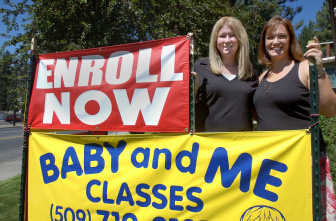
Lisa Williams lost her job but found her passion.
Last spring, her position as a deaf-education teacher in Spokane Public Schools was eliminated, due in part to dwindling enrollment. Rather than look to another school district for work, Williams decided to create her own school.
“I truly believe in teaching kids – both hearing and deaf – to sign. This is my passion,” she said.
So, Williams established Happy Hands Sign Language Center and Bilingual Day Care, now serving children ages 3 months to 3 years. Eventually, she hopes to have a complete program – kindergarten through high school.
Williams’ interest in deaf education began while in college when she took a sign language course as an elective. “I fell in love with the language,” she said. “I ended up taking the rest of the sign classes they offered.”
After getting a degree in special education, Williams enrolled in Western Oregon University’s graduate program, where she earned a master’s degree in deaf education.
She then taught deaf children and special-education students, but she missed her hometown. Last year, she moved back to Spokane and applied for a job with Spokane Public Schools.
“At first, I worked as a sub,” she said. “Then I got a long-term position in a deaf-ed class at Linwood Elementary School.” All her students were deaf or hard of hearing.
But the pink slip came last spring at the end of the school year, and Williams had to find another job.
While in graduate school, she had discovered that the West Coast has numerous deaf-education programs but that Spokane has few.
“There is a huge need for sign language to be reintroduced in this community,” Williams said, noting that many parents in Spokane are choosing cochlear implants for their deaf children.
In the parents’ minds, this solution eliminates the need for signing. Williams disagrees.
“Everybody has a specific learning style,” she said. “It might be auditory or tactile or visual. Sometimes, signing is just better than speaking for some kids.”
What many hearing people don’t understand is that cochlear implants do not offer an immediate fix, Williams said.
Years of training are required before a child can use that tool effectively, she said. Even then, he or she may never master total oral communication.
“But the child gets 100 percent of signing because it’s a visual language,” she said.
Williams’ school is located in Audubon Park United Methodist Church in northwest Spokane.
She chose that facility after careful research. When she discovered the church recently had discontinued its own preschool program, she jumped at the opportunity to fill the gap.
Williams’ staff consists of herself and two others – one hearing and one deaf – all fluent in sign language.
Together, the three have planned their school year. They offer Tuesday through Thursday classes and Monday, Wednesday, Friday classes for two hours each. Parents or caregivers attend with their children.
“We teach the first 100 signs along with activities that parents can use to link the signs to their everyday lives,” Williams said. “These classes are for all children and not limited to the deaf.”
Another aspect of the school focuses on communication between parents and very young children.
Studies have shown that infants’ muscular development races ahead of their speech ability. According to numerous sign language books and Web sites, babies can indicate when they’re hungry or thirsty or when they want a diaper changed by signing rather than crying.
Williams’ “Baby and Me” classes welcome parents of both deaf and hearing children to learn these basic communication skills.
Williams says she hopes her school will meet a need in the Spokane community. “Most deaf students here go to the west side of the state,” she said. “I know several kids who commute every week by plane to Vancouver, for example.”
But Williams wants to change that by offering a quality program in Spokane and by educating the public about signing.
“There are so many benefits in teaching and learning to sign,” she said. “It helps with brain development, it’s fun and kids love it. And it’s a great method of communicating with young children.”