
Boomer Market
After nearly a half-century of living in a three-bedroom house, Mary Pichette is ready to downsize. But before she can simplify her life, the 84-year-old mother of five has to work through the complicated process of paring down a lifetime’s worth of possessions and selling her North Spokane home. “I’ve got a lot of boxes, that’s for sure,” she said.
Pichette is among a group of people who’ve turned to senior real estate specialists to get help with the financial, lifestyle and transitional aspects of buying and selling property. Her Realtor, Kathy Bryant of Keller Williams Realty Spokane, helped Pichette ready her home for sale and is advising her on how to get rid of mementos and household items so she can fit comfortably into a small apartment.
About 15,000 Realtors nationwide have SRES designations, a specialty that focuses on serving the needs of homebuyers and sellers age 55 and older. The course was developed 10 years ago and was adopted by the National Association of Realtors earlier this year as an official designation.
According the SRES Web site, there are 27 designated Realtors working in Spokane, 13 in Post Falls and eight in Coeur d’Alene — although some Realtors serve more than one area.
Tina Hood, a senior specialist with Century 21 Beutler & Associates in Coeur d’Alene, said she took the SRES course about five years ago because this population is – and will increasingly be – a significant force in the real estate market.
“The baby boomer generation is the generation that’s moving and shaking, basically,” Hood said.
Realtors attend two days of classes and must pass a test. Coursework covers retirement income considerations for consumers, as well as methods for attracting older clients and counseling strategies to help clients and customers plan ahead for life transition, the SRES Web site said.
Realtors learn about differences in senior housing, the ins and outs of reverse mortgages and how to use pensions, 401(k) accounts, and IRAs in real estate transactions. Classes also cover how to recognize and protect clients from mortgage finance and loan scams targeting seniors.
“As homeowners age, there is more than ever a need for their needs, rights and interests to be protected,” said Marc Gould, vice president for business specialties for NAR.
Realtors serving seniors build a team of experts, including lawyers and tax professionals, who can help with areas that are outside of their expertise, he explained.
There’s no additional charge for the specialized services that Hood and Bryant provide and they make their living on real estate commissions from home sales, which tend to average about six percent.
“It’s just a service that hopefully will make you a little more marketable,” Hood said.
According to a study commissioned by NAR and released last spring, baby boomers have a higher rate of homeownership than the national average, and one in four owns more than one property.
The study, which surveyed nearly 2,000 people born between 1946 and 1964, found a range of needs. While some baby boomers own multiple properties, others may have not planned well for retirement.
Hood’s clients come from diverse financial backgrounds and include an 80-year-old local woman who is searching for a mobile home for less than $50,000 and a single, recently retired Californian in his 50s who is looking at second homes costing $500,000 to $750,000.
The elderly woman needs a place she can pay for in cash so she can focus her monthly income on the rental land and bills, Hood said, and the man wants a home in an area with a resort feel.
One client is searching for investment property to buy for his kids, Hood said, while a couple needs a single-level home because the wife has arthritis. The Realtor is looking for a rancher that is wheelchair-accessible in case her condition worsens in the future.
What the older clients have in common, she said, is they’re searching for a home that enables them to stay active and independent. Finding places with bedrooms and laundry facilities on the main floor is a priority; multi-level houses can be a major turn-off.
“Some seniors walk in and walk out because they don’t want anything upstairs, period,” Hood said.
Bryant of Keller Williams said she often finds herself working with entire families while trying to represent her clients.
“It’s a very emotional process and often they are still trying to take care of the kids who are often independent,” she said.
The Spokane Realtor connects people with reputable companies than can help find retirement or care facilities, do reverse mortgages or handle entire moves, including boxing things up. Those professionals charge separately.
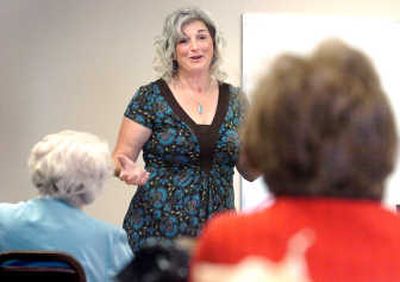
She also helps people downsize belongings by coordinating garage or estate sales or introducing them to auctioneers. Bryant recently conducted a seminar at Corbin Senior Center where she suggested that people wanting to shed a few possessions get out three bins and label them “keep” “give” and “trash” and put things in accordingly.
Gwen Hill, 74, wanted to move from a large apartment and purchase a condo. The former District 81 librarian was an avid book collector.
“When you know you’re in a place that’s not going to hold everything, you have to eliminate things you’re not going to have enough space for,” Hill said.
Bryant and Hill downsized her books, then the Realtor found her a condo near downtown Spokane.
“She was very helpful with all of that,” Hill recalled.
The thought of selling a longtime home can be so intimidating, the Realtor explained, that sometimes people are never ready to sell. Several seniors have been in an information gathering phase for about three or four years. They regularly call with questions, but haven’t listed their homes. And that’s OK, Bryant said.
“You have to be willing to take the time and meet them where they’re at to help them through the process — otherwise they won’t be happy.”