
Car sharing hits campus
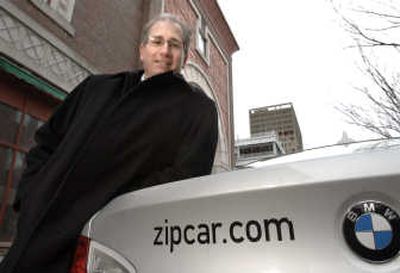
For generations, carless college students have had to rely on their own feet – or bikes, buses and friends’ clunkers – to get around. But a new wave of car-sharing companies is giving kids easier access to wheels.
Companies such as Zipcar Inc. and Revolution LLC’s Flexcar – which allow customers to rent cars for hours or days – see a lucrative new market in students, a population that has been largely ignored by traditional rental-car companies such as Hertz Corp. and Avis Budget Group Inc. Indeed, many rental-car companies prohibit those under 21 from renting at most locations. The car-sharing companies, however, are cutting partnerships with schools nationwide: Flexcar is set to announce deals with Arizona State University and the University of Wisconsin-Milwaukee, and this month it added Ohio State University, the nation’s largest school by enrollment last year. Zipcar, the world’s largest car-sharing company, says it is launching at between 10 and 15 new schools this fall, including Yale University and Carnegie Mellon University, bringing its total to more than 40.
Both companies are also lowering their age requirement at many universities to just 18, making cars available to most of the student body. “It’s underserved,” says Mark Norman, chief executive of Flexcar. The companies also hope to cement students’ loyalty while they are in college – and then keep them as customers after graduation.
Universities are adding the programs in the hopes they will help reduce the number of privately owned cars – and ease the resulting parking crunch – on campus. Schools are also using the programs to allow them to reduce their own fleets of cars. Some also tout their possible environmental impact, since the car-sharing companies offer hybrids and could theoretically reduce emissions by taking some cars off the road.
For Mike Karp, a senior at Columbia University, Zipcar has been ideal for his big grocery store runs – he prefers buying in bulk at Costco – and for collecting relatives at the airport. He left his five-year-old Mazda Protege back home in Palo Alto, Calif. “It just seemed like a great idea in New York because there’s no chance I’m going to have a car there, ever,” he says. “Ten bucks an hour is not exactly cheap, but it’s certainly cheaper than having a car in New York.”
The cost to the customer includes an hourly usage rate, which is typically around $5 to $10, and an annual membership fee, which usually ranges from $25 to $35. Gas, insurance and an allotment of free miles per day – 180 at Zipcar, 150 at Flexcar plus 20 with each additional paid hour – are included. Cars belonging to the programs are typically situated in university-provided parking spaces on campus.
Just like car sharers elsewhere, students reserve a particular car for a particular time either online or by phone, then enter the car by holding their membership card over the car’s card reader. The keys are inside the car, as is a gas card.
Traditional rental-car companies largely avoid the student market because of concerns about liability. According to the Insurance Institute for Highway Safety, the crash rate per mile driven for 16- to 19-year-olds is four times that of drivers 20 and older. Companies seek to mitigate risk through surcharges and higher minimum age requirements. Hertz’s minimum age is 21 in all states except Michigan and New York, where it’s 18; Hertz renters under the age of 25 are also subject to an age differential charge. Avis Budget has a minimum age of 21 in most locations and has a $110 per day surcharge in New York state for renters 18 to 24.
The car-sharing companies, by contrast, are aiming to manage their risk by requiring that 18- to 20-year-old applicants have two years’ driving experience and a clean record, and that they be a student at a participating school. There are no additional fees or deposits, although Flexcar also requires parental consent and a copy of the student’s current auto-insurance policy showing the policy’s limits. Flexcar requires that 18- to 20-year-olds have $300,000 of additional liability coverage. But otherwise, insurance works the same way for 18-year-old car sharers as it does for older ones: In an accident, the car-sharing company’s insurance covers the cost except for a $500 deductible, which applies if the member is at fault.
The car-sharing companies believe they can tap into the younger market safely because of their business model, which allows them to screen customers by their driving record, and because of the clientele. “The reason we see a difference is because we’re a membership-driven system,” says Scott Griffith, president and chief executive of Zipcar.
Norman of Flexcar says that actuarial studies show a correlation between higher education and better behavior among younger drivers. So after successfully running an 18-and-up pilot program at six schools last year, Flexcar is expanding its 18-plus program to all of its schools except the University of Washington, where insurance requirements prevent it from doing so.
“What they have to concern themselves with is six kids getting in a Honda Civic with six-packs in the trunk and driving to the lake,” says Neil Abrams, president of Abrams Consulting Group, a car-rental consulting firm. “That’s the risk.”
There can be some downsides to renting a car whose prior occupants could have been using it as a mobile fraternity party. Because the cars aren’t returned to a maintenance location after every use, as airport rentals are, students sometimes find upon pickup that the cars aren’t perfectly clean or fully fueled. Grace Tomlin, of Cambridge, Mass., who has used Zipcar while at the Massachusetts Institute of Technology, says that one previous user left behind a baking dish, which Ms. Tomlin kept. “I was like, ‘I scored!’ ” she says.
Still, the companies say that upkeep generally isn’t a problem – even with college kids – because shared usage encourages self-policing, since members may find themselves reusing the same car.