
Hands wring while sea lions feast
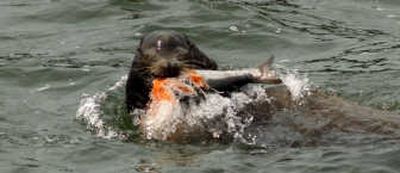
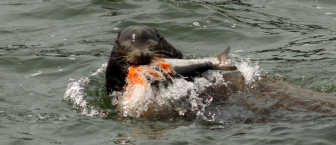
PORTLAND – To Columbia River tribes, California sea lions are salmon-gobbling menaces that have outgrown their need for federal protection, threaten tribal livelihoods and fly in the face of treaty rights.
Animal rights advocates see them as a politically convenient scapegoat used to explain dwindling salmon runs when the real problems lie elsewhere.
On Sept. 4 a broad-based federal task force meets here to make a recommendation to NOAA Fisheries as to whether to allow some sea lions, protected under the 1972 Marine Mammal Protection Act, to be killed to take pressure off salmon runs.
In recent years, sea lions have gathered in growing numbers at the base of the Columbia River’s Bonneville Dam to snack on spring chinook salmon, a mainstay of tribal fisheries, as the fish gather to go up fish ladders toward upriver spawning grounds.
Oregon, Idaho and Washington filed for permission late last year to kill up to 80 sea lions a year below the dam.
An amendment to the 1972 law outlines a complicated process that can lead to permits to kill individual sea lions that are threats to species listed under the Environmental Protection Act, including the spring chinook run. The three states are seeking permission under that amendment.
Some sea lions, whose population is growing fast, have been branded for identification. Others are known to fisheries managers by scars and other markings and have been regular visitors at the dam for years.
But it isn’t simple, and nobody is sure where the process might go.
The task force has 60 days to make a recommendation to NOAA Fisheries on the states’ request. NOAA could decide by spring.
If NOAA approves, it must identify the animals to be killed and specify the time, place and method.
But Charles Hudson of the Columbia Inter-Tribal Fish Commission, which is a strong supporter of the states’ request, said lawsuits or injunctions could snarl things.
An exception to the killing ban has only been tried once, he said, in Puget Sound’s Ballard Locks in the 1990s, where sea lions nearly wiped out a steelhead run that has yet to recover.
It ended inconclusively when three of the worst violators were packed off to Sea World in Orlando, Fla., after public figures including then-President Clinton made pleas for their lives.
But the sentiment is lost on the tribes, who see sea lions as a menace to a way of life and don’t think the critters are cute. They say salmon runs may not have time for what could be a delayed NOAA decision.
So, they also are backing independent legislation to fast-track permission to kill sea lions, HR 1769, introduced by Rep. Brian Baird, D-Wash., and Rep. Doc Hastings, R-Wash.
The bill is not a part of the task force meeting but was inspired in part by time concerns regarding the 1972 law.
Fidelia Andy, chairwoman of the Columbia River Inter-Tribal Fish Commission, told a House Natural Resources subcommittee this month that the observed catch by sea lions this spring was about 4 percent, some 3,500 fish, but that the total take may have been nearer 17 percent, nearly triple the percentage allotted to the tribes.
“Anyone who does not think this is having a profound impact on our people is terribly mistaken,” she said.
She said the sea lion problem violates the spirit of 1855 federal treaties by threatening tribal access to abundant salmon runs.
A strong chinook run is expected next spring.
“If we return to using the same failed tactics we use today, then it will be difficult to answer to the region, the region’s fishermen and the taxpayers who have invested in salmon restoration.” Andy said, referring to nonlethal hazing measures that haven’t kept sea lions from Bonneville Dam.
She said salmon and sea lions coexisted when the river ran freely, but that was changed by the dams.
The dams went in beginning in the 1930s, but sea lions have been a problem for less than a decade, when they first began showing up at the dam in significant numbers.
“We ask our friends in the animal rights community to understand that we are no longer dealing with basic nature,” she said, referring to the dams.
The Humane Society of the United States, a part of the task force, blames the hydroelectric dams themselves, bird predation of young salmon and damage to spawning grounds as among other factors that have reduced salmon runs.
Sharon Young, national marine issues field director for the Humane Society, said established procedure takes too long but the proposed fast-track legislation could bypass needed environmental reviews.
She said existing law can handle the sea lion-salmon conflict by using the environmental review process.