
A caretaking legacy
The lives of the Pulver family have been intertwined with Pines Cemetery for almost 90 years. Through births, deaths, marriages, divorces and retirements, the cemetery has been a constant fixture.
“You just get so used to it, you don’t think much about it,” said James Pulver, 63, who grew up on 12th Street near the cemetery and now is its caretaker. “We used to play over here.”
When he retires, Pulver, the second-youngest of six children, will be the last person with the Pulver family name to be a caretaker unless one of his grandchildren decides to go into the family business.
“The legacy’s gone,” he joked.
For Pulver, working in the cemetery is like working on his own yard. Everyone in his family has worked there at some point.
Connie Vermillion, the cemetery’s office manager, grew up with Pulver and his family. She remembers when she and Pulver would play in grave holes.
“Grandpa Pulver would dig a hole, and we’d get in,” she said. Vermillion, who mainly handles the front office and finances, worked summers growing up, but started full time 15 years ago. She said her family and the Pulvers have been linked for a long time.
“Our children and grandchildren have grown up here,” she said.
The cemetery grew from 5 acres in the 1920s to 40 acres in the 1960s. Another 69 acres was recently added, the largest increase in the cemetery’s history. The Pulver family’s burial plats are in what they call the “old addition,” the land north of 16th Street.
Although Pulver was planning to retire a few years ago, the addition of the 69 acres off 32nd Avenue has prompted him to hold off a few more years. He’s been working full time at the cemetery since 1975. That’s 32 years of dealing with death, burials and grieving families.
“You get used to it, but you never really take it for granted,” he said, his voice getting a little softer. “It’s still personal. It may not be personal to you, but personal to the family.”
Pulver said some burials can be harder than others. Burying children and babies is especially tough, but it’s part of the job, he said.
“You’re doing a good thing for the family,” he said. “You make it the easiest and most comfortable as you can for them.”
It’s a small group of caretakers, so everyone needs to be versatile, said Joe Olsen, the cemetery’s superintendent and Pulver’s nephew. But everyone gets along and pitches in, he said.
“If someone is sick, we all come to work sick. We all give it to each other,” Vermillion said, agreeing with Olsen.
Anything to do with burials, the water systems or landscaping, Pulver’s had a hand in it.
“Whatever it takes,” he said, listing selling and setting stones, planting trees and digging graves among his tasks at work. “If office lady is off, I do sales.”
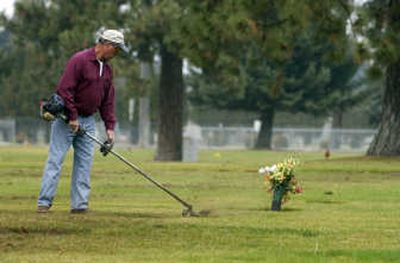
Pulver turned on a weed trimmer. It roared to life. He trimmed the grass and weeds from around the edges of each headstone with clods of dirt flying everywhere. It usually takes about a month or so to weed the entire property. Later, in the shop, Pulver relaxes for a bit before lunch. Although Vermillion said the first burial was in 1904, Olsen said the first recorded burial was in 1907.
“Didn’t you start here in 1907?” he jokes with Pulver, laughing. Olsen picks up a set of sheers. “That’s what Jim used to weed, when he started.”
He calls Pulver “Jim.” Vermillion affectionately uses “Jimmy”.
The shop, built on the site of a former barn, is full of tools and has a few chairs and a table for breaks. A small shed nearby housed the original shop and a small office. The Pulvers tore the barn down in the 1960s and built the shop. The office was built soon after, Olsen said.
“My mom made the curtains for it, that’s how I know,” he said. Olsen’s mom married into the Pulver family when he was in the third grade. He’s been working full time at the cemetery for about 22 years. Olsen lives on the property and can see the office from his window. He remembers when he spent summers mowing grass and doing grunt work part time, much like his son, Casey, 16, did this past summer.
“Cemetery work is not a glamorous job,” Olsen said, laughing. But, like Pulver, he likes working outdoors and not having a boss around.
Vermillion said their bosses are the more than 10,000 people who own a piece of property on the cemetery. Families often buy four or five plots at a time and then pass them on through the generations.
She has come to know some families really well.
“I think it’s really comforting to find me and not a stranger,” she said. “Somebody they can really tell what they feel and what they want, and not feel embarrassed.”
Olsen said it can get very emotional with families, so he just tries to do the job the best he can.
“It’s the worst thing in their life … how can you make it right for them?” he said. “But that’s why I’m not in the office a lot… Sometimes they’re crying. Sometimes they’re not very happy, and sometimes they even yell.”
But it’s their job to take care of the people, he said, echoing Pulver.
Pulver recalled his own family’s loss in September. He had to bury his mother. He seemed to tear up as he talked about it.
“No matter how long you work here,” he said, “it still gets you at some point down the line.”