
Lone Fir offers lessons for life
The 3 Rs of reading, ‘riting and ‘rithmetic were luxuries for the children of Washington’s pioneering farmers, but that didn’t stop them from recognizing the necessity of an education.
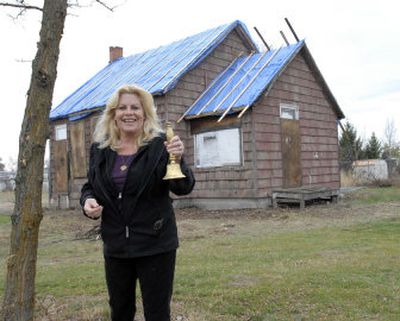
In 1894 the Saltese community built a 24-by-35 foot (the size of a one-car garage) schoolhouse on property donated by Fred Salz. Located on what are now Chapman and Linke roads and using the name of the only tree that shaded the tiny structure, the new school was christened Lone Fir.
Fifteen students from grades one through eight attended the one-room schoolhouse that had no indoor plumbing or heating except a woodstove. Lucy Pike was Schoolhouse No. 128’s first teacher and earned an enviable sum of $30 a month.
“That was on the teacher’s reports we have from that period,” said Jayne Singleton, Spokane Valley historian and curator of the Spokane Valley Heritage Museum.
“The one-room schoolhouse icon is a big part of American history. School was very different; lifestyles were different. For that year there were 36 days of class. Weather was a factor and since this area was agricultural, life revolved around subsistence. In the spring, they planted; in the fall they harvested. In between, they tended to the crops. That was the priority.”
Lone Fir schoolhouse stood robust and sturdy and the 3 Rs were taught within its compact walls until the early 1940s when the school closed. In the late 1940’s an emerging Central Valley School District decided a kindergarten was needed and moved Lone Fir to Sprague Avenue and Progress Road which was also occupied by Vera Congregational Church and Vera School at the time.
“The interior of the school is in good shape and the blackboard is in good shape. It actually has students’ names on it; probably from the time it became a kindergarten,” Singleton said.
Records indicate the first kindergarten teacher was Tella Morgan. “Her son is a dentist in the Valley and he read about the museum acquiring the schoolhouse,” Singleton said.
“He came to the museum and said, ‘My mom was the first teacher and I have her school bell. Do you want it?’” Singleton laughed. “From then on we’ve named this project, ‘Saved by the Bell.’ “
But it was Chuck King, the museum’s most ardent memorabilia collector and recipient of the 2006 Heritage Preservation Award, who first tipped off Singleton about the schoolhouse’s current location which is the new site of Jennifer’s Auto Sales.
“Jennifer (Johnson) is very supportive,” Singleton stated. “The museum owns the schoolhouse but it’s sitting on her property. She’s been very gracious and has donated tarps to cover the roof and will let it sit there until we can move it.”
Seems this schoolhouse has rung a few bells in the hearts of residents and school districts alike. “Every district has written letters of support,” Singleton said.
The students at Summit School, an expeditionary learning school for Central Valley students, did research and prepared a DVD on the history of schoolhouses. “It was very interesting and they were very, very good,” Singleton said of the students’ presentation.
Spring 2008 is the projected time for the Lone Fir schoolhouse’s relocation to the Spokane Valley Heritage Museum at 12114 E. Sprague Ave.
Phase one will include having a contractor prepare the site behind the museum then moving the schoolhouse to the site. Renovation will begin thereafter. “It needs a new roof but structurally, it’s very sound.”
The museum plans to make the exhibit a realistic step into a bygone era. “When you walk in the door, you’ll be in 1894. The schoolhouse will be available for students to attend on a field trip; to have an authentic experience of what school was like in the late 1800s and early 1900s,” Singleton said.
“There will be slates and horn books that the children used during that time. There will be a chalkboard and map. I’m hoping we can piece together more of the story with help from the community.”
An accurate retelling of history depends on people. Singleton is hopeful that the community will share either their story or a relative’s tale about life on the Washington farmlands, of learning in a one-room schoolhouse, of a time when things were simpler, survival was difficult and the fortitude of the human spirit was relentless.
“I’m hopeful the community will embrace the opportunity to preserve the Valley’s history and American history. The one-room schoolhouse icon is a big part of American history,” she said.
“It was a different time and a different life but part of our heritage.”