
Spirit Lake’s popularity boomed in late 1890s
Editor’s note: This is the third in a series of articles exploring the history of Spirit Lake and its environs as the community nears its centennial in August. Spirit Lake native Keith Spencer became interested in local history when he came across some old photographs while remodeling his home. He and his wife, Janette, researched the photos’ origins, began collecting old documents for posterity and now can’t seem to stop.
Peter Rhodebeck remained the area’s only settler for a long time and from meager information his first new neighbor didn’t arrive until well after 1890. It is a tragedy that the 1890 Census records burned in Washington, D.C.; if it was still available, we could be absolutely sure of the timing. Folks passed through, but there is no evidence that anyone stayed very long and it is likely that Pete’s winters were rather quiet.
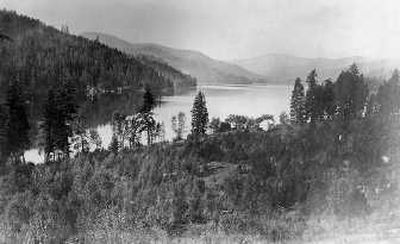
When Spirit Lake was finally discovered, boy was it really discovered. By 1895 there was all manner of activity, both good and bad. There are at least three reasons for the sudden popularity. First, the Indian trail had finally been widened into a wagon road (much of the credit here must go to the Poirier brothers; Joe in Rathdrum, Louis in Spirit Valley and Albini, who founded Albini Falls). Second, the local papers, including The Spokane Falls Review, the Coeur d’Alene Journal and the Rathdrum Silver Blade, had all sent reporters to the lake; their reports were glowing. Finally, Spokane had become a real city and quite prosperous. Its citizens had money in their pockets and they were yearning for places to go. In truth, they picked Spirit Lake because it was a place of beauty and charm amid unspoiled wilderness.
The pleasure seekers, pioneers and land speculators arrived at the same time. The newly completed Northern Pacific railroad, running through Rathdrum, also had a major impact, both beneficial and questionable. As a land-grant railroad, the NP was given alternate sections of land on either side of the track, including some in Spirit Lake country. By 1895 there were two steamers sailing the lake and a number of tenting (as camping was then called) resorts on its shores. Early visitors included the mayor of Spokane, the president of the Bank of Spokane, the head of the Spokane Chamber of Commerce and numerous doctors, lawyers and preachers. Some even brought their own cooks and restaurant accommodations. According to the newspaper accounts, all were enchanted by the experience.
It is not possible to separate those settlers who came and homesteaded as permanent residents and those who came, built summer homes and departed when the snow started falling. It really doesn’t matter as some of the summer dwellers made the biggest contributions to the taming of the area. According to Chester Phillips, who wrote the first “History of Spirit Lake” in 1941, the first arrivals were Rhodebeck, Peter Samuelson, better know as “Swede Pete,” Charlie Sauderstrom, Johnnie Crandall (an alias?), Colonel Samuel and Marion Wharton and Ole Anderson and his family. Phillips is mostly correct, but there are a number of other early residents that deserve to be added to this list of pioneers. After Rhodebeck, their particular order of arrival is not known, but most are associated with exceedingly interesting stories and you will soon hear more about them.
Colonel (a southern gentleman) Samuel Wharton and his wife, Marion, were first noted in 1891. Their initial interest was likely piqued by land speculation. However, they soon became hooked by the ambience of Spirit Lake and became major players. Samuel, originally from Texas, was rich, owning much stock in several successful gold mining ventures, particularly the Reco Mining Company in British Columbia. He was a shrewd businessman, taking great delight in trading any kind of property that came into his hands, including the purchase of a circus at a sheriff’s sale and making considerable profit by selling off the components to a zoological den in Cincinnati. He also ran a camping site and the steamer Reco on Spirit Lake.
Samuel may have owned gold mines, but Marion was the real mover at Spirit Lake. In addition to purchasing vast acreage in the area, she built the first frame house high on the bluff on the east shore of the lake. She was a socialite and was noted for her hospitality. At one time she owned most of the waterfront property on Spirit Lake and was a wealthy woman in her own right. Marion along with many others experienced difficulties with some of her early purchases. She purchased a fair amount of land from the NP, which almost immediately went into receivership. The Central Trust Co. of New York filed claim on her property, and it was several years before both she and the NP were able to retrieve what was rightfully hers. She must have been feisty as she once accused her neighbor, Rhodebeck, of assault. After the Rathdrum trial of the year, Pete, who would never harm a squirrel, was acquitted and we will likely never know what actually happened.
Johnny Crandall is a big mystery. According to Phillips, Crandall sold the mill site to the Panhandle Lumber Company, but county records show that a Swiss named John B. Krienbuhl is the man who homesteaded that property. To complicate matters, a pioneer of Spirit Valley wrote that he and his father stopped to see a John Kramble at the same location and ate delicious squirrel stew during the stop. I am convinced that Krienbuhl is the right name. He either had aliases or had his name badly mangled by the locals. After selling to the Panhandle, he moved to the Rathdrum area and eventually ended up in Spokane. He must have been pretty tough as he got into an altercation with some thugs on a streetcar and got both beaten and shot, but foiled the robbery. He is last remembered as holding high office in the Spokane Oddfellows.
Ole Anderson is another heavyweight in early Spirit Lake affairs. He and his family homesteaded several miles above the head of Spirit Lake on Brickle Creek. Everything, including a cast-iron stove, had to be ferried up the lake and then packed to his cabin. Eventually, after proving up the homestead, he and the family moved to town, likely to allow the children to attend school. Another early settler, George Campbell, jumped Ole’s claim and moved into his cabin. Ole found out about the takeover and confronted Campbell. A battle ensued. Campbell shot at Anderson and missed. Anderson, in no mood to be charitable, quickly planted a shovel against Campbell’s head, ending the altercation. The pair showed up in court with Campbell’s head still in distress; assault charges were quickly dropped and the judge awarded the homestead to Anderson as long as he coughed up a few bucks for Campbell’s improvements.
Ole was a pretty smart character as he held onto the homestead until well after the Panhandle Lumber Co. had commenced logging operations. After much dickering, he sold off just the valuable white pine logs for a big price and lived very well for a long time. Several generations of Anderson’s were prominent in the Village of Spirit Lake and a great-grandson, Jeff Anderson, still lives there, keeping the Anderson tradition alive.