
Driving circles on the tundra
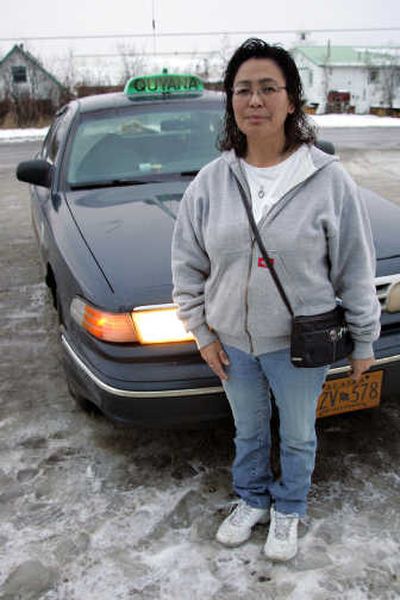
BETHEL, Alaska – A tiny, round-faced woman stands in a field of ice, a solitary figure in the tundra, waiting for a ride. From one hand dangles several plastic grocery bags. With her free hand she flicks a finger as if inscribing a single scratch in the air, an almost imperceptible gesture.
A taxicab appears from a cloud of mist. It is an old, white Chevy, so splattered with mud there’s hardly any white to see. On the roof glows a green sign that reads KUSKO.
“Hello dear,” the driver says.
“I’d like to go home,” says Lucy Daniel, folding herself into the back seat among her bags.
Daniel, 65, a Yupik Eskimo who grew up riding sled dogs and seal-skin kayaks along the Bering coast, now takes a cab everywhere she goes: To work or church or, like this afternoon, to the general store to pick up supplies, and then back to her house.
It’s because of residents like Daniel that this village in Alaska’s remote southwest has become the unlikely taxicab capital of the United States. Bethel (pop. 5,800), buzzes with 93 taxi drivers, or roughly one cabbie for every 62 residents.
That’s far more taxi drivers per capita than anywhere else in the United States, according to Alfred LaGasse, executive vice president of the Taxicab, Limousine & Paratransit Association, the nation’s largest cab organization.
Furthermore, Bethel has only about 10 miles of paved roads, which means there are nine cabdrivers per paved mile. Dirt roads, branching off the main arterials, add another 20 miles. These side streets, pockmarked by pond-size depressions, are sometimes negotiable, sometimes not.
The taxi drivers spend most of their time on the paved roadways, which form a loop connecting the most popular destinations: two general stores, the post office, the hospital and the airport.
“That’s what I do: go in circles,” says Bilal Selmani, the cabdriver who has picked up Daniel. Everyone calls him Lincoln. “Every hour, every day, every month. Round and round. Thirty years.”
Longtime drivers know everyone in town by face, first name or address. They know most everyone’s stories.
They overhear arguments and love-struck whispers, they listen to confessions and tall tales and regrets. They pick up children from school. They shuttle travelers to and from the airport. They deliver everything – moose meat, groceries, heavy-machine parts. They chauffeur all-night revelries, wedding parties and sometimes the dead.
The majority of riders are Yupik Eskimos. The taxi drivers – most of them Albanian or Korean immigrants – have their own tales, spanning continents and oceans but ending here, in a spot on the American frontier that most Americans have never seen or heard of.
Lincoln stops in front of a small square house in a subdivision of small square houses called Tundra Ridge. Daniel eases out, hands him seven $1 bills for the 5-minute drive. The flat rate is $5 per passenger in town, $7 per passenger to the outskirts.
“Bye,” Daniel says. Like many who live in Bethel, she originally is from Tuntutuliak, a nearby Yupik village that survives on fishing and hunting. Daniel moved to “the city” in 1971 because, she says, “there was nothing for me in Tuntutuliak.”
With her five children grown and her husband gone, Daniel spends mornings working in a school cafeteria. She never learned to drive, because, she says, “big machines scare me.”
In any case, she can’t afford a car, and even if she could buy a junker, she couldn’t afford to have it transported to Bethel – it would cost between $2,000 and $4,000 by barge or plane.
No roads lead to Bethel. What Daniel calls a city is a dusty, disheveled conglomeration of shacks and warehouses in the middle of the Yukon-Kuskokwim Delta, a treeless, permanently frozen plain the size of Utah.
Bethel, 40 miles inland from the Bering Sea and 400 miles west of Anchorage, is the hub for 56 Yupik villages that sprinkle the tundra like flakes of dried seaweed. A traditionally nomadic people, Yupiks began living in fixed villages such as Bethel only in the past 50 to 100 years.
They come to Bethel to work. It’s also the only reason outsiders come here. Bethel, the governmental and commercial center of the region, is a no-frills working town, where people draw wages in construction, freight, government administration and air travel. Then there are the taxis.
For Lincoln, the path to the American Dream led from a farming town in eastern Albania, where he was born, to Connecticut and finally here.
“I ask friend, ‘Where can I make money fast?’ He tells me Alaska. I drive eight days to Anchorage.” A friend in Anchorage told him he could make a killing driving a cab in the bush.
Lincoln, 53, has been a taxi driver in Bethel since 1977. He is short and stocky, with deep-set eyes and a prominent Roman nose. When he first arrived in the bush, he had a long, black beard. One of his earliest customers, a native, marveled at his facial hair. “You look like Abraham Lincoln,” the man said.
From then on, Bilal Selmani went by the name of the nation’s 16th president. Most villagers don’t know his real name.
For the first 25 years driving a taxi, Lincoln worked 12-hour days, seven days a week, for nine months of the year. He would spend three months with family in Albania. Although his earnings might seem meager to many Americans, they represented a bounty for farmers in Albania. Word spread of his good fortune, and soon other Albanians trekked to Bethel to drive in circles for cash.
For a time, between the late 1970s and early 1990s, Albanians dominated the taxi business. Today, more than 100 townspeople claim Albanian ancestry.
Six years ago Lincoln brought his wife and two sons here. One son, Perparim, 24, drives graveyard. When Lincoln finishes his shift at 5:30 p.m., Perparim takes over for the next 12 hours.
When the car breaks down, his other son, Lumni, 27, an auto mechanic, fixes it.
After dropping off Daniel at her home, Lincoln’s workday proceeds like many other days, with routine pickups and drop-offs. He finishes an airport run, then picks up a young woman and her infant daughter. The woman, in her early 20s, is crying.
Lincoln helps her load the trunk with moving boxes. “It’s a happy day. I’m finally free,” says the woman, who has just broken up with her boyfriend. “Happy, happy,” she says through tears. Soon her baby starts crying, too.
Lincoln picked her up at a dilapidated trailer on one side of town and drops her off at a dilapidated mobile home on the other side.
“My life can begin,” she says. Lincoln helps her with the boxes, each one labeled. Baby Clothes. Stereo & Music. Stuff.