
I-5 reopens earlier than expected
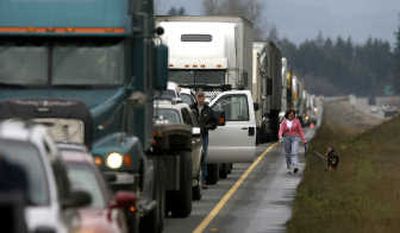
OLYMPIA – Flood-ravaged Western Washington got a taste of recovery Friday as state crews reopened Interstate 5, putting thousands of vehicles back on the road after more than three days of complete shutdown.
For countless others, however, the work was nowhere near finished. State officials waited for word of federal disaster aid, and business owners, farmers and everyday residents faced massive cleanup and repair efforts.
“We applaud your resilience and your can-do attitude,” said Maj. Gen. Timothy Lowenberg, the state’s emergency management director. “Citizens of the state of Washington are showing the indomitable spirit of Washingtonians at their very best.”
The aftermath of violent storms that cut electric power, destroyed buildings and caused widespread flooding could linger for months.
Six deaths were blamed on the disaster: four people in southwestern Washington and a pair of hikers in the Cascade Mountains. At least one person also was missing, but police in rural Winlock considered their search for the man a recovery mission, not a rescue.
Opening I-5 in the Centralia area was a critical step forward. Officials had predicted the main artery connecting Seattle and Portland would remain closed at least through the weekend, after Chehalis River flooding closed a 20-mile stretch that was covered by up to 10 feet of water.
After working around the clock and finding less structural damage than they anticipated, Transportation Department crews were able to reopen the freeway’s northbound and southbound lanes to all traffic just before noon Friday.
Freight trucks had begun rolling Thursday night, after one lane in each direction was restored. Officials said about 54,000 vehicles crossed the area each day under normal circumstances; each day of the shutdown cost the state economy an estimated $4 million.
Those who survived the storms and floods already were deep into the long, difficult work of getting back to normal. Soggy piles of furniture, carpeting and other household items were a common sight across the flooded region, and some had started burning big piles of destroyed belongings.
In King County, the state’s largest, officials said nearly 200 residents had reported more than $4.2 million of uninsured damages to their homes. More than a dozen businesses said their uninsured losses topped $520,000.
Near Chehalis, dairy farmer Linda Styger and her husband, Andy, were among the residents helping out their less-fortunate neighbors.
The Stygers’ home and their animals, sitting on a high spot in the Chehalis Valley, escaped the worst of the flood. But fellow farmers in the nearby Boistfort Valley “basically lost everything,” Linda Styger said Friday.
“You’ve lost the animals, you’ve lost your facilities, you’ve lost your feed – you’ve lost your livelihood,” Styger said. “I don’t know how you recover from that.”
Meanwhile, utility crews kept working to restore electricity to thousands of people.
Fewer than 17,000 remained without power by midday, mostly in Grays Harbor County, and “that number keeps dropping every day,” Lowenberg said. Grays Harbor County officials said full electric service probably wouldn’t be restored for another week.
Government and volunteer workers continued delivering food, water, medicines and other relief supplies to storm-damaged areas. Isolated places along the coast, including tribal communities, were being targeted, Lowenberg said.
Gov. Chris Gregoire was still awaiting a response to her request of a presidential disaster declaration, which would speed federal assistance to Washingtonians. She planned a fourth aerial survey of the damage today, joined by Sens. Patty Murray and Maria Cantwell and Rep. Norm Dicks, all D-Wash.
“Her commitment is to take care of people first,” Lowenberg said. “Of course, we will take care of public infrastructure damage … when we have made sure that people are taken care of.”