
Otis Orchards fixture
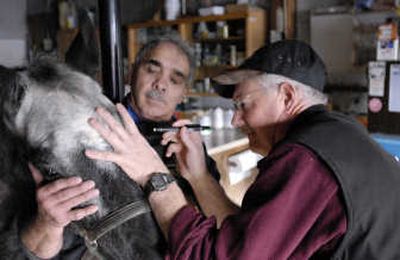
Whether a creature crawls, flies or gallops, Jerry Ponti has likely examined several.
From the hawks he rehabilitates to the pampered household dog, Ponti serves them all. He is one of the few animal doctors remaining in the region still offering a mixed practice as a large animal veterinarian along with care for small pets, and everything in between.
Marking his 30th year at his Otis Orchards animal hospital, Ponti has no plans to slow down – even when making those predawn calls for birthing a calf.
“I’m going to keep going until I get run over by another horse,” said the 61-year-old Ponti. “That’s how I can tell I’m getting older. I can’t get out of the way of them as fast.”
“I don’t have any retirement plans. I can only hunt a few weeks a year. I’m not a couch sitter.”
As he gives a tour of his 6,000-square-foot animal hospital, two of his dogs trot along. The canines share a similar liver-and-tick coloring but make an odd pair: P.D., for Ponti’s Dog, a sleek German shorthaired pointer, and Becker, a stout dachshund.
He has another shorthair, Stella, as well as a few horses and cows kept in nearby fields. Ponti has always been around animals; he and a brother and sister grew up on a family dairy farm in the Yakima Valley town of Prosser. That meant 4 a.m. milkings, 7 a.m. to school and 8 p.m. to bed – after the cows were milked again.
His veterinary career started 33 years ago. After graduating from Washington State University, he practiced for three years in Lewiston then opened the Otis Orchards clinic in 1977. Ponti and ex-wife Linda raised two children, now living in Whitefish, Mont., Jey, a physical therapist, and Jena, a landscape architect.
On his six acres at Starr Road and Wellesley Avenue, Ponti’s first 3,000-square-foot clinic building remains, what he calls his hunting and fishing headquarters. “I have two bad habits – hunting and fishing,” he said, followed by a short pause, “and horses. That’s three expensive habits.”
Ponti’s modern animal hospital, built in 1999, has an operating room, exam areas, offices and a kennel in the back for boarding animals. Three other veterinarians work there in addition to Ponti. The staff includes those working at the clinic for most of its 30 years, including Ponti’s sister, Judi Dailey, who helps run the practice, and Betty King, semiretired, who can anesthetize “anything walking, crawling or flying,” he said.
Ponti also has long provided veterinary care to wildlife, a volunteer role he describes as a way to give back to the outdoors he enjoys. He is authorized by the U.S. Fish and Wildlife Service to do raptor rehabilitation and wildlife care, working along with rehabilitator and technician Marilyn Omlor.
Ponti has treated a variety of species over the years: calf moose, orphaned fawns, juvenile bald eagles, elk with a broken leg, two pet cougars after they tangled with a porcupine, and a bear cub that escaped from one of his kennels before being recaptured.
“The bear cub was a little, tiny thing,” Ponti said. “There was blood everywhere, mostly from me. His mother got shot, and he was an orphan.”
On typical days, however, Ponti cares for horses and cows intermixed with office sessions for household pets. Another barnlike building on the property is set up to care for large animals with stalls, X-ray and ultrasound machines, an operation room with sawdust shavings and hay bails, and a cow chute.
Ponti still makes calls in his truck to farms and ranches, in addition to the cows and horses brought to him, but he admits he is seeing less of this type of work overall.
“I used to do 80 percent large animal. Now it’s about 20 percent large animal, and I do most of it.”
Other things about the profession have changed over the past 30 years, Ponti said.
“Primarily diagnosis. Thirty years ago, we didn’t do a lot of lab work. Now it’s routine. We didn’t do a lot of dental work on dogs and cats and now it’s routine.”
And veterinarians themselves are more specialized. Most specifically treat one category of animals, such as equine veterinarians.
“A lot of vet practices have gotten away from the old country-style rural practice where they’d work on whatever came in. The old mixed animal practitioners are a dying breed because the vets coming out of schools today only deal with horses or small animals or food animals.”
When reflecting about his 30 years, Ponti doesn’t see his career as work. He enjoys the challenge of caring for an animal in the most economical way for a client.
“The vet profession is a way of life for me. It’s not a job. I feel really blessed to do something that after 30 years I have a passion for. Not many people can say that.”