
Agents on patrol for real pests

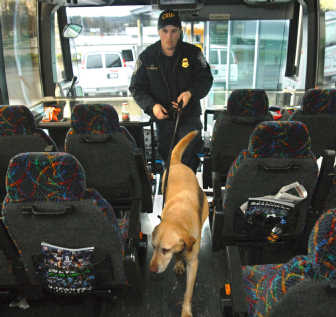
BLAINE, Wash. – The yellow Lab circling an enormous, refrigerated semi-truck is not searching for illicit drugs, bombs or people being smuggled in hidden compartments.
This dog may be targeting guava fruit, hunting trophies or buffalo meat.
He is part of one of the less-publicized aspects of border control. Here, at the Pacific Highway truck crossing in Blaine, nearly 40 specialists, including two dogs, are trained to intercept pests and plants that could pose grave threats to American agriculture.
Experts say foreign insects and non-native plants could devastate domestic flora, and meats can carry threats like mad cow disease, bird flu or foot-and-mouth disease.
“The probability is very remote,” said John Giannini, agriculture chief of Customs and Border Protection. “But it’s still there, and we have to act.”
The department’s staff has doubled in five years, after the Sept. 11 attacks caused leaders to increase U.S. Customs and Border Protection staffing across the board.
On a recent day, specialists randomly selected an empty truck for inspection, tapping inner walls and using flashlights to examine floor grooves for seeds.
“We’re looking at the floor, ceiling, wheels,” Giannini said. “We look at the pallets that hold (products) for wood-boring insects.”
Giannini said while working in Tacoma he once discovered such insects in the folds of wrapping that covered a shipment of lychee, an Asian fruit. The shipment had been through an intensive freezing process designed to kill pests.
“I let them thaw out for 30 minutes and they started wiggling,” he said. “Insects will always surprise us and find a way to survive.”
Specialists say perhaps the majority of items confiscated at the border come from innocent travelers, ignorant of the potential hazards their Iranian dates or Vietnamese vegetables might pose.
Sometimes commercial carriers will not disclose a truck’s contents, perhaps in an effort to pass through the border more quickly.
“It’s happened where the truck’s refrigerator is running, but the driver says he’s carrying paper,” Giannini said. “We’d check that. If we’re suspicious of anything, we’ll have them take the entire load out.”
Noncommercial violators may receive a $300 fine for a first offense, or more for repeat offenders.
“If they say they don’t have it and we find it, that could be a problem,” Giannini said.
Commercial violators can be fined $1,000 or more. If officials can prove a driver intended to conceal a product through smuggling, criminal charges may also be filed.
Once seized, the department disposes of produce by grinding it in a commercial garbage disposal, killing any potential pests, Giannini said. Meats are shipped to Oregon to be incinerated.
As Giannini strolls past a long, winding line of travelers, he recalls an elderly woman visiting family from Russia who rose from her wheelchair to protest the confiscation of apples she had picked from a tree in her hometown.
“It’s a tough job sometimes, because of all the emotional issues,” he said. “People wonder, ‘Why are you taking my food? I’m going to eat that.’ “