
Chinese parents favor foreign toys for kids
SHANGHAI, China – When freelance writer Wang Jian shops for toys for her 5-year-old son, she’s happy to pay extra for Legos blocks and Japanese-brand train sets.
The reason, she and other parents say: Foreign brands enjoy a reputation for higher quality – a perception reinforced by the product scares of recent months.
“We pay close attention to the news about toy and food safety. If I find a problem with a certain brand, I will just stop using it for sure,” said Wang, who writes for film magazines.
China may be Santa’s global workshop, but when it comes to buying playthings for their own children, Chinese families who can afford it opt for foreign-brand toys – even if they are made in China.
Quality and safety issues are drawing more attention as incomes rise and upwardly mobile Chinese grow more health conscious. While virtually all toys on the market, whether foreign or domestic brands, are made in China, factories making foreign brands are assumed to abide by more rigorous standards to screen out lead paint and other harmful materials.
“I dare not buy cheap wooden toys or toys with paint,” said Lin Yan, a professor at Shanghai International Studies University, whose 7-year-old daughter tested for elevated levels of lead in her blood.
“I have a stupid standard: I buy her expensive toys in big department stores. I can only assume most of the expensive ones are foreign brands and are guaranteed to have better quality,” said Lin.
When her daughter is given toys she suspects are unsafe, she throws them away.
“Sometimes they have indescribable odors,” she said.
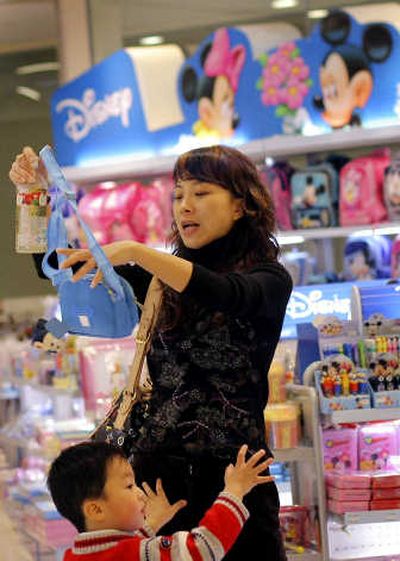
The preference is evident in the gargantuan New World Department Store in Shanghai’s commercial heart.
Shelves are crowded with foreign-brand models and remote-control cars, the ubiquitous Legos from Denmark, Mattel Inc.’s Barbies, Transformers made by Japan’s Bandai.
Chinese-brand toys are crammed into a few shelves stacked with dolls and toddler toys made by Star Moon Toys, a manufacturer in the southern city of Dongguan that also makes toys for some of the world’s biggest brands.
China’s toy market is still in its infancy. Domestic retail toy sales totaled $603 million in 2006, according to Chinese government figures. That’s a fraction of the $22 billion in U.S. toy sales last year, according to the research firm NPD Group.
The culture lacks an equivalent to the Christmas holiday toy binge in the United States; traditionally, children are given clothes and money for the Lunar New Year, the most important holiday in the Chinese calendar. It falls in February in 2008.
But times and tastes are changing. China toy sales are growing about 20 percent a year as living standards rise with the buoyant economy. Since most urban Chinese are limited by government policy to having one child, families are willing to spend lavishly on their sole offspring, especially for books and educational toys.
Nationwide, most Chinese families devote less than $10 a year to toys, according to industry estimates. But families in Shanghai, Beijing and other major cities spend more than that in a month, according to a study by the Hong Kong Trade and Development Council.
Tales of poor quality Chinese toys abound – dolls whose heads fall off, bicycles that rust and puzzles that don’t fit together. Such products are rarely seen in Western markets since the quality is far below what a foreign buyer would accept.
Foreign toys only began making inroads in China in the past 20 years as Hong Kong manufacturers began shifting production across the border in the 1980s. Though local toy brands accounted for 60 percent of sales in China last year, the top tier of the market was dominated by foreign-branded toys, the research group Euromonitor said in a recent report.
The summer safety scandals – in which millions of Chinese-made toy cars, trains, action figures and jewelry were recalled in the U.S. – also helped foreign toy companies. The government is now requiring many toy makers to qualify for safety and quality certifications, standards that foreign firms are used to meeting.
Also helping foreigners lead the way is adroit marketing, tying in merchandising campaigns with television shows and movies. Mickey Mouse and SpongeBob SquarePants products abound, despite government-backed promotions for Chinese cartoons.
At Haiping Toys, a typical small neighborhood shop in a working-class Shanghai suburb, shopkeeper Liu Yuping’s 7-year-old son knows the prices of all the toys, models and video games – mostly Hong Kong and Japanese brands.
“That’s 108 yuan (about $15),” he said of a sleek, silvery foreign-brand yo-yo. “It’s expensive but it’s really good.”
Local-brand yo-yos were piled on a table outside the store – priced at about $1.20.
“The foreign-branded products definitely sell better. Those are the ones the kids want,” said Liu. “The quality’s just so much better. The others, well … .”