
Raptor rehab planned
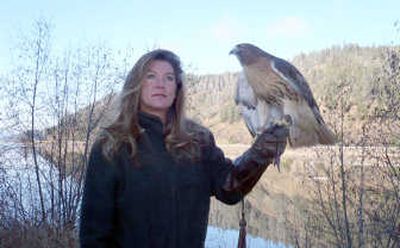
As a female bald eagle soared inches above Lake Coeur d’Alene’s glassy surface, an undistinguishable prey in her clutches, a quick flutter of her six-foot wingspan had her up and perched atop a post to feast. That performance, however innate for the raptor, caused a chain reaction along the Wolf Lodge Bay exit. Once the first minivan and its spellbound occupants pulled to the shoulder, car after car followed suit.
As Jane Cantwell looked on, the scene unfolding almost 30 yards offshore demonstrated exactly what the group she’s involved with, Birds of Prey Northwest, is trying to preserve. Cantwell, a raptor biologist and president of the nonprofit group, is leading an ambitious plan to build a raptor educational center on a hill overlooking Wolf Lodge Bay.
“The reason we chose this area for a raptor center just flew up,” Cantwell said, while watching the human infant-sized raptor from the road.
As the peak season ramps up for the bald eagles’ annual migration through the Beauty Bay area, with about 150 expected in early January, the reasons to preserve the area and the kokanee salmon population that attracts the birds become all the more apparent.
“This is an important part of the Idaho birding trail. This is an important migrating route for these birds,” Cantwell said.
On a 50-acre plot of land just north of Interstate 90 that Cantwell owns, the proposed 10,000-square-foot educational center would offer visitors an up-close opportunity with the four members of the raptor group: owls, eagles, hawks and falcons. The roughly five-year, $4 million project would include two wings: a state-of the-art educational facility for displaying Cantwell’s collection of eagles, hawks, owls and falcons in their natural habitat settings, and a private medical section for injured birds of prey, with the goal of reintroducing them into the wild. The design takes inspiration from Boise’s World Center for Birds of Prey and the University of Minnesota’s Raptor Center.
For Cantwell, the facility would be the culmination of her more than 20 years of working to protect raptors and educate the public, mostly through licensed programs that allow her to show live raptors, including a 16-year-old, nearly 14-pound female bald eagle named Liberty.
Cantwell, along with other members of the Birds of Prey Northwest group, work closely with state and federal agencies, handling all calls involving an injured raptor.
“I’ve been doing this for about 20 years, and it’s always been my vision to have a public center,” said Cantwell, who’s also a master falconer in the sport of hunting with a trained raptor. “There’s lots of need for what we’re doing, both in terms of education and in terms of rehabilitation.”
Cantwell also sees the center as the meeting grounds where people can reconnect with all birds of prey species. “We’re all connected to the natural world,” Cantwell said. But given today’s tech-driven society and wired world, “we gradually lose touch with wildlife,” she added.
For local wildlife preservationists and veterinarians alike, the idea for a raptor educational and rehabilitation center is a natural fit.
“There isn’t anything like a center in the area,” said Kris Buchler, a raptor biologist and former president of the Coeur d’Alene chapter of the National Audubon Society who is also a Birds of Prey Northwest board member. “Through the education center, we’re trying to teach the public that these animals are important. With the center open, there’s also a better chance of raptors being brought in and rehabilitated and released into the wild.”
As the number of injured birds continues to increase, with an average of 100 a year due mainly to vehicle collisions, gunshots, poisoning and electroshock, the medical wing would provide veterinarians, who currently volunteer their surgical services for injured raptors at a few area animal hospitals, all the necessary equipment in one location.
“I think having a facility in the area is a really good idea,” said Fintan Maguire, a veterinarian at Kootenai Animal Hospital who helps Cantwell with injured raptors once a month on average. “Since so many people in the area enjoy the outdoors, it’s a great way for people to get in touch with, and give back to the animals.”
However, despite support for the center, there is still a long road ahead.
“This is a heck of an undertaking,” said Wayne Melquist, a wildlife biologist and retired Idaho Fish and Game state nongame biologist who supports the proposed center.
As someone who’s worked closely over the years with Cantwell’s nongovernment affiliated group, Melquist said he recognizes the need for a rehabilitation and education center. “(Birds of Prey Northwest) really saves the department and state a lot of time and energy,” he said. With a new state-of-the-art center, he added “There’s no other (place) in the state that could serve that function.”
Cantwell also recognizes the obstacles the facility faces.
“In order to grow the facility and grow the mission, you need to have a bigger member base. It’s difficult to get people excited about birds unless they’ve had an experience with one,” she explained.
Even though funding and operation issues remain, Melquist said Cantwell is the right person to lead the way. “This is just a love she has, and a passion. She just wants to help these birds,” he said, adding that the work is essential to the raptors’ continued presence. “We’ve got to continue to try and get the word out.”
Parked along the alcove in Wolf Lodge Bay, Cantwell said people don’t realize their direct impact on the airborne migrants. With any change in the environment, she said raptors are often the first to suffer, such as with the DDT pesticide used decades ago that took a heavy toll on bird populations.
“From that experience, we learned that these birds are bio-indicators; they are barometers of the environment,” she said. So if the lake’s kokanee salmon population took a hit or their habitat was lost, the bald eagles would be forced to move on, Cantwell said. “I hope that the public would see an appreciation and understanding of a species that can tell us a lot about our own future.”