
Fossil losses plague Oregon monument
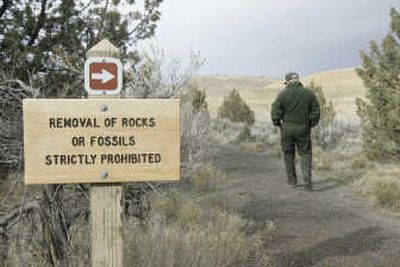
JOHN DAY FOSSIL BEDS, Ore. – Some summer days, National Park Service Ranger Scott Ritner can simply sit on a bench underneath a gnarly juniper tree and watch people commit a federal offense.
They’ll hop a low wooden fence at the base of Leaf Hill, pick up the bleached rocks that litter the ground and pocket the fossils the John Day Fossil Beds National Monument was named for.
“That’s kind of our problem child,” said Ritner, the ranger for the Painted Hills unit of the monument.
There’s a trail around Leaf Hill, and informational signs with examples of some of the different fossil types found there – ancient sequoias, alders, pines, oaks, even magnolias. The signs tell people what’s there, he said, and it’s human nature to search among the flat white rocks for them, pick them up and keep them as a souvenir.
While the rules about what people can collect vary depending on who manages the land, the illegal removal of fossils from public lands in the John Day Basin is a continuing problem, said staff with both the park service and the Bureau of Land Management.
While people pocketing imprints of leaves are a concern in the monument, the theft of fossilized bones from mammals, including creatures distantly related to pigs, happens as well. In one case this year, a search warrant was issued for people who were spotted digging in the monument; the search turned up multiple fossils, including bones from a rhinoceros.
And when people remove fossils illegally, they take away part of the prehistoric story of Eastern Oregon that scientists are trying to piece together.
“It’s not the thing; it’s the story,” said John Zancanella, a Prineville-based paleontologist for the BLM in Oregon and Washington. “When an illegal collector collects, and it goes into a shoebox or a closet, the benefit is for no one.”
It’s difficult to quantify how often fossil theft happens, he said. But the evidence of it can be easy to see, he said.
There are fossil sites that he checks on to find holes – some small, some 3 feet across – that weren’t there before and weren’t done by a permit-carrying researcher.
In the fossil beds, there are places where scientists have taken pictures of fossils on the ground and come back later to find them gone, said Ted Fremd, chief paleontologist at the monument. And there are other places where people have dug pits or tried to remove bones but did a messy job of it, he said.
“We have a large amount of land, and we have a lot of fossils on it,” said Jim Hammett, superintendent for the 14,000-acre fossil bed monument. “In general, we depend on the public to help us out.”
A lot of the rangers’ efforts are aimed at education, Ritner said. He’ll go up to people and talk with them about the park and answer any questions they have – “Where are the dinosaurs?” is a common one, he said, but all these fossils are from the post-dino ages.
But he’ll show them the ones that are common on the Painted Hills unit. On sedimentary rocks bleached from the sun, the outlines of the short needles of the ancient metasequoia or veins of old alder leaves stand out in different shades of brown.
And he’ll explain the monument’s rules, such as not taking fossils or not walking on the fragile surfaces of the painted hills.
For the most part, people behave, he said. Still, he patrols the Painted Hills area regularly, covering the different trails about five times a day.
In his patrols of the trails and other areas of the unit, he’ll see people taking chunks of rocks, he said.
The fossil beds are unique because they present an incredibly long record of what lived in the area, from about 50 million years ago to about 3 million years ago, Hammett said. While other fossil deposits might be more detailed about a particular time, the national monument contains fossil records that can give scientists glimpses into the evolution of different animals or of entire ecosystems. In that way, the John Day Fossil Beds are kind of like a book, he said.
“There’s a lot of fossil deposits that are like a single page of a book, and we have the whole book.”