
House a ‘godsend’ for military families
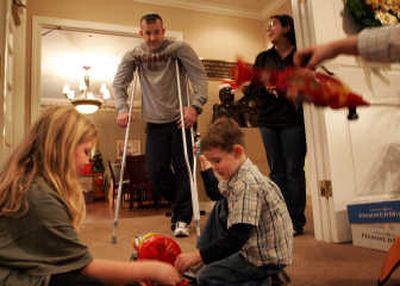
FORT LEWIS, Wash. – Like a lot of Army spouses, Sora Oakes figured she’d be better off back home with her family rather than staying on base while her husband, Sgt. 1st Class Don Oakes, was in Iraq.
So when he deployed in April, she and their son Connor moved out of their quarters at Fort Lewis and in with her folks in Tennessee.
That worked fine – until Oakes got hurt Nov. 9. He suffered a badly broken leg when a wall collapsed onto him during a mission in Diyala province.
In a few days he was at Madigan Army Medical Center, and Sora and 4-year-old Connor were back at Fort Lewis in need of a place to stay.
Like hundreds of other military families who have found themselves in similar circumstances, the Oakes family found a home away from home at Fisher House.
“It’s been a godsend, I’ll tell you that,” said Sora Oakes, who figured she was looking at an extended costly hotel stay to be close to her husband while he recovered.
Instead the family is living for free in one of the seven suites at the Fort Lewis Fisher House. It’s part of a nationwide network of 38 such facilities that opened in 1990 to help military families through medical emergencies.
The Fort Lewis house was built in 1992 and generally runs at 96 to 98 percent capacity. This past year it’s been full, said house manager Jodi Land.
There are long-standing plans for a second Fort Lewis house, but they’ve been temporarily shelved while the foundation builds new houses near VA hospitals, including one in Seattle, that are located away from military installations.
The house at Fort Lewis features cozily furnished rooms. Residents share a large dining room and a kitchen stocked with donated groceries.
Volunteers bring in donated dinners most nights.
There’s a laundry room with donated top-of-the-line appliances, Wi-Fi with a laptop for each room, a big TV and video games for the kids. And the house is within walking distance of Madigan.
“It’s been a lot less stressful than it could have been,” said Sora Oakes. “It’s been nice not to worry about dinner every night, and there’s everything you could want at home. It’s been wonderful.”
The Oakeses are hardly alone in their appreciation.
Since the first Fisher House opened at the Bethesda Naval Medical Center in Maryland in 1991, support has mushroomed. The Fisher House Foundation is rated A+ by the American Institute of Philanthropy and received more than $25 million in contributions and public support in 2005, according to its most recent tax return.
It has an array of high-profile business supporters, including CNN, Wal-Mart and salad dressing magnate (and retired movie star) Paul Newman. Doonesbury cartoonist Garry Trudeau donated the royalties from his “Long Road Home” books.
Most of the major U.S. airlines participate in the foundation’s Hero Miles program. It provides free airfare for family members who must travel to be with injured service members.
The foundation builds the Fisher Houses and turns them over to the Department of Defense or the Department of Veterans Affairs, which are responsible for day-to-day operations and maintenance. The foundation handles donations that enhance the programs at each house.
Land, the local Fisher House manager, and Diane Debiec, Madigan’s deputy chief of social work, said the local operation has seen its share of large-dollar donations.
“There are a lot of very generous people out there,” Land said.
These days about 40 to 45 percent of the families at the Fort Lewis house are there for a service member hurt in Iraq or Afghanistan, Land said.
The more traditional residents are like Ellen Hoepner, of North Pole, Alaska, whose 15-year-old son Zane Jacobsen arrived at Madigan in September for six months of treatment for osteosarcoma, a common form of bone cancer in children.
Zane’s dad is retired from the Air Force so he’s covered under Tricare, the military’s health insurance program.
Hoepner, a nurse, never gave a second thought to coming down to Madigan to be with Zane.
“But I hadn’t thought at all about where I was going to stay, or what I was going to do,” she said.
Madigan social workers put her in touch with Fisher House. She hadn’t even heard about the facilities until she arrived at Fort Lewis.
Zane’s care at Madigan has been top-notch, Hoepner said. And though he’s in a great deal of discomfort now while he undergoes chemotherapy, his prognosis is good and they have high hopes for his recovery.
But she says she’d be in a far more difficult state without her temporary home just down the street from her son’s hospital room.
“I’d be going deep into debt if I had to stay here on my own to help take care of him,” Hoepner said. “I can’t say enough good things about Fisher House.”
The network of comfort homes for military families was created in 1990 by New York real estate magnate Zachary Fisher and his wife, Elizabeth. Today there are 38 Fisher Houses at military installations across the United States and in Germany, with five more under construction, including one at the VA Medical Center in Seattle.