
Scarlet Firethorn (Pyracantha coccinea)
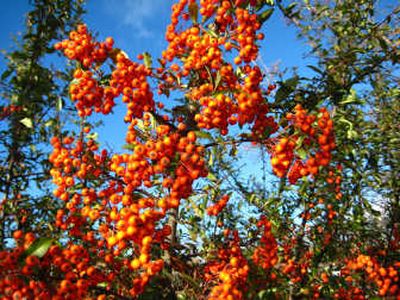
When we focus on plants that add color, texture or structure to the winter landscape. Scarlet Firethorn, which many gardeners know better as Pyracantha, easily fills the bill. This evergreen woody shrub holds onto its glossy, dark green leaves through the winter. It is best known for its berries which will brighten any dreary fall or winter day. They range from orange to red in color and will remain on the plant well into the winter.
Firethorn, which is related to Cotoneaster, is native to southeastern Europe, the Himalayas and central China. It prefers full sun but will also tolerate partial shade and is very easy to grow.
The plants have fragrant clusters of small white flowers in the spring which develop into fleshy berries that ripen in September. They are a favorite of birds. Sources differ on whether the berries are edible for humans but they are not poisonous. I have seen recipes for Firethorn jelly but they require a lot of sugar which tells me the berries probably don’t taste so great.
They are very versatile in the landscape. They can be pruned as a standard, trained up walls or fences, used for hedges and as security barriers because of their thorns. Many gardeners train the branches into an espalier or topiary. They make a stunning accent plant.
Firethorn can be pruned at any time, but watch out for those sneaky thorns. The plants can be kept to a desired size by pinching off new shoots or pruning shoots that have already fruited back to a strong side branch.
There are many Firethorn cultivars that are hardy for this region. ‘Chadwickii’ grows to six feet, ‘Gnozam’ is four to six feet and has a spreading habit. ‘Kasan’ reaches a height of eight to 10 feet but is more compact. ‘Lalandei’ and ‘Wyattii’ are more vigorous, topping out at 12 feet. The most hardy cultivar is ‘Monon,’ also known as ‘Yukon Belle.’ Hardy to zone 4 and a cultivar of Pyracantha angustifolia, it reaches six to eight feet. More compact varieties include ‘Red Elf,’ ‘Ruby Mound’ and ‘Lowboy.’