
Harper Joy made circus part of his life
Long before television, movies and even radio, the circus was one of the most popular and accessible forms of entertainment for many families. And often children dreamed of running away to join the circus.
James Harper Joy, known as Harper Joy, was one of those children. Only he waited until he was an adult to fulfill that dream. Local author Doris Woodward chronicles Joy’s life in her recently published book, “Spokane’s Man of Many Faces, Harper Joy, Let the Show Begin.”
Woodward said Joy moved to Spokane in 1923 and took a job as a bond and securities salesman for Joel E. Ferris. His love of theater and performance was already firmly established. “Harper left home before high school graduation and joined the vaudeville circuit,” said Woodward. He traveled the country, performing a minstrel act in blackface.
Eventually, he returned home to Walla Walla and worked his way through Whitman College. After moving to Spokane, he bought a home on 21st Avenue, and married Dorothy Mendenhall in 1926.
That home became the first link between Woodward and the Joy family. “I live right next to Harper Joy’s home on the South Hill,” she said. The home is well-known in Spokane, because Joy purchased a full-size locomotive and railroad tracks and installed them in the backyard. He christened it the Cannon Hill and Pacific Railroad. The railroad was a gift for his children and for the neighborhood kids as well.
Though Joy was a successful businessman with a young family, he’d never gotten over the wanderlust that propelled him to vaudeville. In the spring of 1929, he and a friend “ran away” with a circus for three weeks. According to Woodward, Joy made his debut riding atop an elephant in the circus parade.
That first jaunt prompted an annual tradition. Each summer Joy would join a circus for a few weeks. He drew on his experience in vaudeville and developed a clown act. However, he wasn’t the only prominent Spokane citizen with a fascination for the big top.
“Louis Davenport had an early interest in the circus,” said Woodward. The two men were friends and business contemporaries. In fact, Davenport decided to honor Joy in a unique fashion. Tucked away on the seventh floor of the Davenport Hotel is a most unusual room. Dubbed the Circus Room, it’s the only place in the hotel that remained relatively unchanged during the recent renovation.
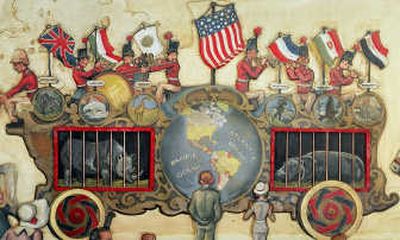
When visitors step through the door, they step back into the heyday of the circus. The light fixtures are clusters of multicolored glass balloons, but what really catches the eye is an around-the-room mural of a circus parade. “It’s a great piece of folk art,” said Tom McArthur, director of communications for the hotel.
The mural depicts elephants ridden by Indian rajas, zebras pulling a Roman chariot, caged lions, calliopes and clowns.
“We believe the room was meant as a surprise for Harper Joy,” McArthur said. Famous circus performers are featured in the mural along with local dignitaries. McArthur said, “From what we can see, the figures represent Harper Joy’s friends.”
According to Woodward’s book, the Circus Room was begun in 1935 when Davenport hired a sign painter, A. Rutgers Van der Loeff, to decorate the room. Van der Loeff incorporated unusual items, like carpet tacks to make a horse’s bridle. Small pieces of welders brazing rods form a leopard’s cage. Harper Joy is depicted in one section of the mural with his hat jauntily askew and a cigar clamped between his lips. Amazingly, the mural is thought to be carved from a roll of gray cardboard.
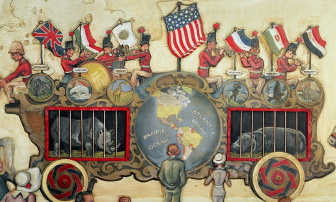
“The thing I find most intriguing is the statement to history,” McArthur said, pointing out a circus wagon topped with various national flags. Several of the flags have been defaced. “Legend says that during World War II Louis Davenport personally altered the flags of the Axis powers,” McArthur said. “Davenport reportedly said, ‘No flag of our enemies will appear in my hotel.’ “
Though the Circus Room was created to honor Joy, he had other interests besides clowning. His public speaking skills proved valuable during World War II, as he championed the war bond effort. Under his leadership, Spokane County surpassed every bond quota. He met many celebrities during this time, including radio personality Ralph Edwards.
Edwards remembered Joy when he launched his radio program, “This is Your Life.” Woodward said, “Harper was the 10th person featured on the program.”
Joy died in 1972, but his widow lived for many years in their South Hill home, and their son Ed, the youngest of their four children, currently lives on a farm just south of Coeur d’Alene. In addition, the family maintains their Liberty Lake cabin, where much of Joy’s circus memorabilia is displayed.
When Woodward gazed out of her upstairs window at the Joy home many years ago, she couldn’t have envisioned how well she’d get to know this family. “This started out as a magazine article,” she said of her book. “But I could tell in the blink of an eye that I had more than enough material for an article.”
The affection she feels for her subject is evident in the way her eyes light up when she speaks about him. “I spent a lot of time laughing as I wrote,” Woodward said. “I really feel like I know Harper. I can’t imagine writing anything more fun.”