
Historic Hayden home for sale

A piece of Northwest history is for sale.
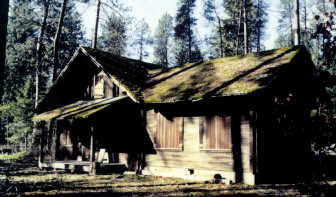
Near the shores of Hayden Lake, at the end of a narrow, one-lane road, beneath red-barked ponderosa pines, nestles a rustic cottage, probably the smallest house in a neighborhood of new, impressive homes. But the cottage with the “For Sale” sign planted in its front lawn boasts an enviable pedigree, plus a listing in the National Register of Historic Places.
The cottage is the lone survivor of a seven-building, 45-acre, country estate built by early-day mining magnate John A. Finch, who more than 100 years ago commissioned the region’s foremost architect, Kirtland K. Cutter, to design a country retreat.
Over the years the cottage has been known by several names. According to its current owners, Greg and Debra Anne Bishop, people sometimes call it “The Gingerbread House,” because of its Swiss chalet design of wide eves, decorative brackets and scallop trim. The “Lost Cutter” is another name attached to the house, not because it has somehow gone missing but because the wrong address was given on its National Register nomination, a mistake that has not been corrected.
Officially, in the National Register, the cottage is listed as The Finch Caretaker’s Cottage. According to the nomination, the cottage is important not only because of the role of its owner in the development of the region but also because of its architect and unique, decorative detail he embodied in the Finch estate architecture which differed from his other chalet designs.
Finch was born in England but came to the United States as a young boy. He arrived in the Coeur d’Alene mining district in 1887 and, partnering with Amasa B. Campbell, accumulated far-reaching and diverse investments that extended to Canada, Alaska and Washington state. The investments included mining, real estate development, retailing and banking.
Finch became secretary of the Coeur d’Alene Miners Association and ultimately, as owner of the Gem Mine, had a role in the mining war of 1892. Miners refused a 50-cent wage cut levied against the underground, hard-rock miners. Gem became an armed camp with guns in the hands of both miners and those siding with the mine owners.
After it was discovered that a Pinkerton spy was passing union secrets to Finch, a gunfight broke out, followed by the dynamiting of an abandoned ore mill at the town of Gem, which resulted in several deaths. Ultimately federal and state troops were called in to quell the violence. From this revolt of the mine workers, the Western Federation of Miners was born. Finch also served in the Idaho Senate in 1891.
In Spokane, Finch had commissioned architects Cutter and Ernest Malmgren to design and build a home in the prestigious Browne’s Addition close to the home of his partner, Campbell. The colonial revival mansion with its white, frontal columns, was completed about 1895 and still stands at the west end of Browne’s addition.
In the fashion of the wealthy at the turn of the century, Finch wanted a country home and again asked Cutter to be his architect and design a summer retreat on Hayden Lake. Construction of this house, a Swiss chalet, began in 1903 and was completed in 1904. Cutter designed the chalet, much like his own home in Spokane. It was a design he used for other projects, including the lodge at Glacier National Park’s Lake McDonald.
The two-story Hayden chalet, constructed of squared-off logs and overlooking the lake, had 20 rooms, balconies, heavy-beamed ceilings and massive, stone fireplaces. There were six additional buildings, including a laundry, gazebo, a chicken house, boathouse and the caretaker’ house.
Finch died in 1915 and eventually the landscaped grounds were platted and sold off in city-sized lots. Finch’s widow sold Chalet Laken in 1926, and the house for a time became a summer resort. On the night of April 21, 1930, the chalet burned to the ground. Today, only the caretaker’s house and the foundation of the chicken house remain as one reminder of the great wealth taken from Idaho ground that prospered the mining elite.
After the fire, the caretaker’s house went into a downward spiral. According to Greg Bishop, the house was, at one time, converted to a duplex.
“We had a man stop by one day who wondered if we would mind if he took pictures of the house,” Bishop recalled. “He said he had lived here when it was a duplex and remembered the night the main house burned.”
He added, “Eventually, the caretaker’s house was not used and fell into disrepair. I’ve talked to people who remember coming out here – when it was deserted – to party.”
He explained that the house was saved in 1992 by Tom Hundhausen, a Spokane native, who bought properties in disrepair and fixed them up. “He did a lot of research, even visiting one of Cutter’s chalets on Spokane’s South Hill, to make sure he got it right. He lived here while he worked on it.”
Hundhausen’s attention to detail is evident in the careful restoration of the decorative trim of roof line and around doors and windows. Some early alterations and additions made, probably just after Finch’s death, matched the original so well that the authenticity of the house was not compromised
The Bishops bought the house from Hundhausen in 1998 and, Greg said, have made no changes except for paint. “My wife likes decorating and design and she added brighter colors to the exterior trim.”
He said that his family has enjoyed living in the historic house and hopes there will be new owners who will preserve it and appreciate both it and its history.