
Pilgrims lament passing of hajj
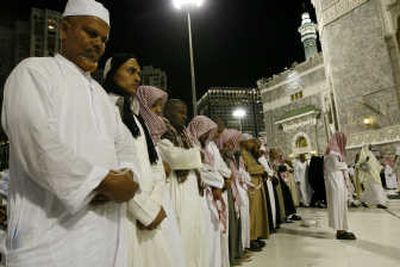
MECCA, Saudi Arabia – After five days of exhaustion and hardships, Muslim pilgrims were saddened to see the annual hajj close Friday, ending what for many is a spiritual high point of their lives.
“Bidding farewell is hard,” said Afaf al-Nuweihi. “I wish I could stay longer – in a place of worship where you pray and get closer to God.”
Al-Nuweihi, a 61-year-old retired teacher from Egypt, spent nights during the hajj sleeping on roadsides in her tent and her days moving from ritual to ritual with 3 million other pilgrims.
“I feel I am born again. Hajj is all about enduring hardship and suffering in order to wash away our sins,” she said. “I hope God will give me strength to sustain my hajj spirituality after I get back home because it’s going to be difficult for me to come back again.”
Amina Hallaq, 47, of Syria, sat on a plastic mat on the pavement. “I’d be even happy if we could stay at least another week,” she said. “Believe me, I am sad to be leaving.”
After performing the ritual of stoning pillars that represent the devil in Mina on Friday, pilgrims proceeded to Mecca to bid “farewell” to the Kaaba by circling it seven times in the final rite of the hajj. Muslims around the world face the cube-shaped stone structure draped in black cloth during the five daily prayers.
The pilgrimage ended without any major incidents, but even as the pilgrims were preparing to journey back to their countries Friday, the Interior Ministry announced it had arrested a group of militants plotting attacks on the holy sites.
Interior Ministry spokesman Mansour al-Turki said the arrests came about a week ago but gave no further details. Saudi-owned satellite television station Al-Arabiya reported those arrested were Saudis.
Thousands milled through the massive four-story mosque in the center of Mecca housing the Kaaba and completed the final steps of their pilgrimage.
“It is a difficult and bitter thing,” Fadhel Abdallah, a 33-year-old Yemeni petroleum engineer, said as he sat in the mosque reading his Koran. “The atmosphere here is so spiritual that one cannot experience it anywhere else.”
Above the Kaaba, on the mosque’s third level, a pair of Pakistani friends watched the slow, hypnotic movement of the faithful around the courtyard.
“When you simply look at the Kaaba you feel rewarded by God,” said Usman Haidar, a 32-year-old in the Pakistani army. “It is difficult to leave this place; anyone who comes here is the luckiest person because God has brought them here.”
His companion, Nadim Haq, a 43-year-old businessman, said pilgrims always feel lonely when they depart “because they leave part of themselves behind.”
Friday was the last day of the three-day holiday of Eid al-Adha.
On the last day of the hajj, pilgrims also walk the distance between hills in Safa and Marwa, re-enacting the search by Abraham’s wife, Hagar, for water for her infant son Ishmael in the desert. After her seventh run, the spring known as Zamzam emerged miraculously under Ishmael’s feet.