
Service honors homeless dead
Bob C. Smith. Clarence Bradford. Rex Taylor.
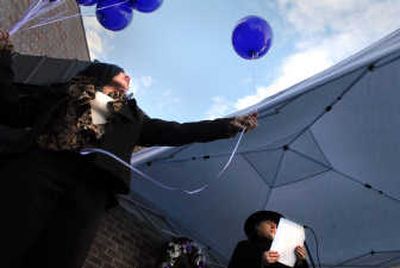
Those names and those of 20 other homeless people who died in Spokane County this year were read aloud Friday at the Homeless Persons’ Memorial Day ceremony, held in the courtyard outside the Denny Murphy Clinic downtown.
“We’ve picked this, the longest night of the year, to commemorate those who have passed on,” said Peg Hopkins, president and CEO of the Community Health Association of Spokane, as trucks rumbled by on Monroe Street and about 40 people gathered in the chilly courtyard.
While most homeless people die from untreated health problems, Friday’s cold weather was a good reminder that many die from exposure to the elements.
For each name read, a purple balloon was released into the winter sky.
“I think we have a few more balloons this year than last,” Hopkins said. Homelessness has been a big issue this year, with a tent city moved between neighborhoods and the eviction of low-income people from downtown apartment buildings putting the spotlight on the need for low-income housing.
Those who work for the homeless want to keep the issue at the forefront.
“I’ve always called for a reality connection for everyone,” said Hopkins. “This is the hardest time for us and for what we do.”
This year, CHAS served 6,000 individual homeless clients in Spokane, out of a total of 35,000 patients seen by the agency’s clinics.
“The number never seems to go down,” Hopkins said.
Mental illness is a big problem.
“The national statistic is that 70 percent of all homeless people have mental illness,” Hopkins said. “About 10 percent of homeless want to live outside the boundaries but the rest want to live just like us.”
It’s easy to forget that homeless people also have families, Hopkins said during her speech.
“Most people think of the homeless as single orphans in this world, but that’s not the case,” she said. “They had families, mothers and fathers, families who tried their hardest to keep them inside their circle.”
Mental illness can make it especially difficult for families to take care of homeless relatives, she added.
A mayoral proclamation was read and local gospel singer Kenny Andrews performed. Al Chidester played a song he wrote about a homeless man who was attacked and burned to death in his wheelchair last year.
“I met Doug Dawson on June 6, 2006. I was waiting at a stoplight out at Fairchild and he was crossing the street in his wheelchair – some of the bags he had hanging from it got stuck in the spokes and he was right there in front of me,” Chidester said. “He was in awful shape, he had no place to live, he was trying to hitchhike to Davenport to see if his mom’s house had sold.”
Chidester said he helped Dawson with a ride and some better bags for his belongings, before dropping him off on East Sprague.
On the day the news of Dawson’s death ran in the newspaper, Chidester talked to a woman at the stand where he bought the paper.
“She said she knew Doug Dawson and he was her best friend in the whole world,” Chidester said. “So someone who may seem useless to everyone else can still be the best friend to someone in this world.”
Toward the end of the memorial service, volunteers put out toothbrushes, hats and socks to be passed on to homeless people.
“We have got to remember that this, the longest night of the year, gives way to the return of longer and longer days,” Hopkins said.