
Training facility in use
Here’s a definition of a great job: You get paid while enjoying learning or perfecting your skills.
The Coeur d’Alene Police and Fire departments have a sparkling new facility where the players are doing just that.
The city’s five-story steel training tower and associated outbuildings at Ramsey Road and Kathleen Avenue behind Fire Station 2, have been in operation since Oct. 13.
Based on observation and conversations with firefighters and cops, it’s obvious that the 2.5-acre facility is living up to its advance billing as a state-of-the-art “playground” for those charged with protecting us.
And over the long haul, the complex should save the city money since it will no longer have to pay other jurisdictions rent for their facilities and overtime for Coeur d’Alene police officers and firefighters to train in them. Further, the city will collect rent from other departments that use the facilities.
The 50-foot tower dominates the complex, but $2.2 million of a $7 million bond also bought the city two classrooms, a remodeled kitchen, dorm rooms, men’s and women’s restrooms, a storage garage, a weight room with donated equipment, a “mat room” where officers practice defense and arrest techniques and a paved area suitable for practicing traffic stops, controlling traffic and removing victims.
A principal user of the new facility is the Special Response Unit, a special weapons and tactics team composed of nine Kootenai County sheriff’s deputies, eight city police officers and their canine teammates.
Police Department training Lt. Bill McLeod said the team has been practicing twice a month in the facility since it opened, honing skills that will enable them to rescue hostages, overcome a barricaded bad guy, capture or take down a shooter, clear a building or help a downed officer.
During a recent practice, the team, led by Sgt. Erik Turrell of the Police Department and the Sheriff’s Department’s Sgt. Dennis Stinebaugh, was using two floors to “capture” an armed man, using a German shepherd to search the building, then locate and help subdue the villain.
McLeod explained that no live ammunition is used in the building, so team members were armed with conventional automatic weapons altered to fire paint balls made of soap that the officers call sim rounds. The marks they make on the walls are simply hosed off at the conclusion of an exercise.
So far, the props that the team uses include a mannequin and several bales of hay, but McCleod says the policemen and firemen intend to build partitions to form an office, bedroom, kitchen and living room with metal furniture such as beds, couches, desks and a stove that can withstand the fires that players will light as part of their drills.
Also to be added as resources permit is a smoke machine.
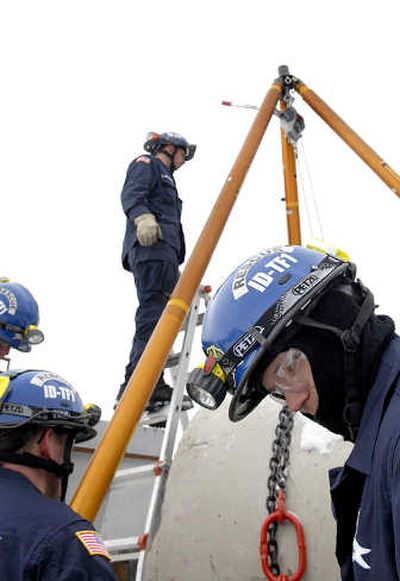
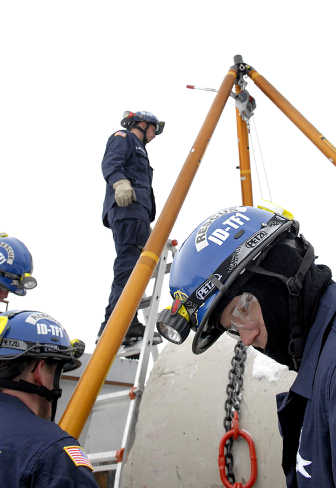
Deputy Fire Chief Jim Washko notes that several tunnels run from the tower’s basement to a concrete trench where the Fire Department’s 21-person, two-dog Urban Search and Rescue Team practices trench and tunnel rescues.
That team, by the way, will soon grow to 28 and will add two more dogs trained to find victims.
The team can practice rappelling, either outside on the building’s walls or inside, down a 60-foot simulated elevator shaft. And the tunnels will give firefighters practice working in a confined space.
In addition, the tower roof will be used by firefighters to practice ventilation, and it has balconies for practice hose lays.
The new facility will play a part in training not only professionals, but volunteers as well. On Jan. 3, 30 to 40 reserve police officers from the five northern Idaho counties will begin their schooling, to be conducted Tuesday and Thursday evenings plus weekends through April.
And in the spring 350 firefighters from the northern half of the state will participate in a weekend-long fire academy, training that, in the past, has taken place in a tower rented from the Spokane Valley Fire Department.
Outside agencies are already expressing interest in the new Coeur d’Alene facility. Washko said he’s received inquiries from the Spokane and Fairchild Air Force Base Fire departments plus a Boise-based Civil Support Team that identifies hazardous substances and mitigates their effects.
“It’s going to take another year at least to completely finish the facility, and that includes a lot of self-help by police and fire personnel,” Washko said.
“But in the meantime, it’s going to be used hard. It’s really a blessing for everyone.”