
Campaigning hot as caucuses near
DES MOINES, Iowa – After a pause for Christmas, presidential contenders today resume their blitz across Iowa, scraping and scuffling in contests that have grown tighter and more unpredictable as the first balloting of 2008 nears.
On the Democratic side, three candidates – Sen. Hillary Rodham Clinton of New York, Sen. Barack Obama of Illinois and John Edwards, former senator from North Carolina – are running neck-and-neck-and-neck, with the rest of the field fighting to squeeze past one of them to finish third.
Among Republicans, former governors Mike Huckabee of Arkansas and Mitt Romney of Massachusetts are battling for first place, while the race for third is a toss-up among several contenders.
The closeness of the caucus contests here increases the import of these final days – and any verbal misstep, breakthrough TV ads or crystallizing moment on the campaign trail – in what already have been exceptionally fluid races.
Iowans will vote Jan. 3.
“We’ve never had anything like this,” said David Nagle, a former congressman and past chairman of the Iowa Democratic Party, who has been tracking the caucuses since they gained national attention in 1972. “If you can find a three-headed coin, flip it. That’s about the best projection I can give you.”
While the approach of Christmas had kept the candidates on relatively good behavior – especially in their warm-and-fuzzy TV spots – few expected their reluctance to attack to last all the way into the new year.
“It’s probably going to be harder for them to restrain themselves,” said Peverill Squire, who teaches political science at the University of Iowa. “They’ll be trying to draw more comparisons and contrasts among themselves.”
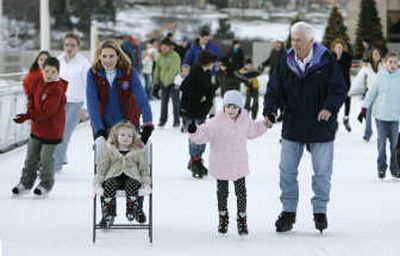
With just eight full days of campaigning left, Christmas amounted to little more than an extended dinner break for many of the White House candidates and their harried staffers. Democratic Sen. Christopher Dodd of Connecticut, who has taken up temporary residence in Des Moines, had the state to himself and spent part of the day ice skating with his family and campaign team.
Clinton and her husband, former President Bill Clinton, will join former Iowa Gov. Tom Vilsack and his wife, Christie, in the Vilsacks’ hometown in the southeast part of the state, before the Clintons part ways to stump separately.
Another Democrat, New Mexico Gov. Bill Richardson, begins his day in southwest Iowa, while Obama threads his way through the north. Sen. Joseph Biden of Delaware plans a rally today in Des Moines.
On the Republican side, Huckabee plans to start his day with a pheasant hunt in southern Iowa while Fred Thompson, former senator from Tennessee, resumes his bus tour a few towns over.
In all, eight candidates and two spouses will storm the state, according to the Iowa Democratic Party, which tracks campaign events by contenders from both parties. But that’s just a start.
Between now and the caucuses, every one of the major presidential hopefuls will visit Iowa, including three – Sen. John McCain of Arizona; Rudolph Giuliani, former New York mayor; and Rep. Ron Paul of Texas – who up to now have spent little time here.
“As the race moves along, the Republicans are starting to see you really can’t skip Iowa,” said Chuck Laudner, executive director of the state GOP.
New Hampshire, which has been Iowa’s twin at the front of the presidential nominating calendar for the past few decades, holds the nation’s first primary Jan. 8. Analysts believe a candidate has to finish somewhere in the top three in either Iowa or New Hampshire to be able to seriously compete in the contests that follow.
Edwards and Romney planned to campaign in New Hampshire today before resuming a full schedule of Iowa events Thursday.
The onslaught in Iowa reflects its centrality to the presidential contest, despite the efforts of politicians in more populous places – including Michigan, Florida and California – to cut the state down to size by moving their contests up to January and early February. All that Iowa’s detractors managed to do was to elevate the state’s import and add uncertainty by pushing the campaign into the heart of the holiday season.
“This is really a caucus like no other,” said Jeff Link, a longtime Iowa Democratic strategist and Edwards supporter. “Everyone feels they need to get in as many visits and events as they can between the 26th and the 3rd because it’s close. Everyone’s going to try to do everything they can in these closing days.”
The caucuses have turned out to be the most competitive Iowa has seen since 1988 – perhaps ever. Then, as now, there was no presidential incumbent running, resulting in hotly contested races on both sides. But in 1988 – when the caucuses were held Feb. 8 – there were clear front-runners: then-Sen. Bob Dole of Kansas on the Republican side and then-Rep. Richard Gephardt of Missouri in the Democratic race. Both held on to win as expected.
By contrast, Clinton, Edwards and Obama have all led the polls in Iowa and enjoyed front-runner status at different stages of the Democratic race The latest surveys, taken in aggregate, show the three just a few percentage points apart, with their support ranging from the low 20s for Edwards to the high 20s for Obama and Clinton.
“It seems there’s a rotation among them,” Nagle said. “One will have a good day and seem to surge ahead, then another will have a good day, and then another. They seem to reach a plateau and no one can break away from anyone else.”
On the Republican side, the race held steady for most of the year, with Romney enjoying what long appeared to be a comfortable lead. Huckabee, a favorite of Christian conservatives, climbed slowly through the summer and fall, then roared past Romney in November. The question is whether the Huckabee campaign, which has operated hand-to-mouth until recently, has the voter-turnout organization to capitalize on his strong showing in surveys.
An aggregate of surveys shows Huckabee’s support in the low 30s and Romney in the low 20s, with the rest of the field much farther back. But the race for third on the Republican side could prove nearly as consequential. McCain, Thompson and Giuliani are all looking to avoid an embarrassing finish that could harm their chances in New Hampshire and beyond.