
Hero’s welcome for Spokane Chief
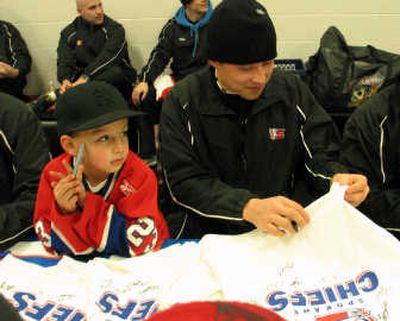
East of the Rocky Mountains, where the winter air is so cold it burns your lungs, members of the Blood Tribe gathered to celebrate one of their own.
Dozens of children watched as the Spokane Chiefs took the rink for a short practice at the Kainai Community Center in Standoff, a town on the outskirts of Lethbridge, Alberta.
The end-of-November event marked the beginning of Spokane’s five-game swing through Alberta to take on teams from the Central Division.
It was a day to celebrate the Western Hockey League’s top team – and its overage forward Judd Blackwater. He is the third member of the tribe, Canada’s largest, to move from minor hockey and spend a major junior career in the WHL, the highest level of play in Canada.
“It’s not every day that a player comes off the reserve,” said Carmen Blackwater, Judd’s mother.
At the end of the Chiefs’ demonstration, kids from the tribe laced up their skates and grabbed their sticks.
Between playfighting and scooting around the ice with adoring children glued to their sides, the Chiefs seem to be having just as much fun as the youngsters that idolize them.
Soon a banner will drape the wall, joining the Saskatoon Blades and Lethbridge Hurricanes posters already in place from previous visits by the two tribal members – Wacey Rabbit and Clay Plume – who played in the league before Judd.
“That was a good day for our team,” said Spokane coach Bill Peters. “It was a proud day for Judd and I know our guys were proud to see Judd at home and in his environment and being honored …
“Anytime you can see where everybody is from and add a cultural experience, it makes us all a little wiser.”
The impact of Judd Blackwater won’t be measured in the somewhat modest numbers he has put up this season – 12 goals and 13 assists in 35 games, fifth on the team in scoring. Blackwater, a sturdy left-winger, spends his time mostly on the Chiefs’ second or third line, depending on the night.
Back on that day in November, though, Blackwater was the hero – the toast of the tribe, humbled by the acknowledgment.
“It’s great to (go) back home and see my family and all the fans that support me,” Judd said. “It’s been a dream since I was a little kid for the other kids to look up to me.”
Growing up, Blackwater “wasn’t like the other kids,” said his brother, Kes Blackwater. “He grew up on the reserve, but he didn’t spend much time there.”
At the age of 11, Judd Blackwater moved off the reserve to Lethbridge, to live with Kes, while remaining close to his parents. It was a decision based on one thing: hockey.
“If he would have stayed in Fort MacLeod, he probably wouldn’t have made it this far,” Kes Blackwater said. Fort MacLeod and Standoff are neighboring towns.
“Keep in mind this was almost 10 years ago,” and very few kids moved off the reserve to pursue such opportunities, said Blackwater, now 30. “Nowadays, more and more, it can happen. Judd’s kinda shown the way to some of the younger kids.”
While some kids were getting into drinking and drugs, Kes – only 21 when they started living together – assumed a disciplinarian role in Judd’s life. Judd listened and stayed centered.
“He showed me the ropes,” said Judd. “I love my dad to death, but (Kes) was a big father-figure to me, for sure.”
Judd, who didn’t play in his first WHL game until he was 18, eventually had to choose between golf – a sport for which he had natural talent – or hockey.
He won the Future Links Western Champions golf tournament as a 17-year-old and qualified for a team that traveled to Scotland and played at Carnoustie.
But his heart belonged to hockey, a game he considers more challenging.
After this season, Judd hopes – like most hockey players – for an opportunity to move on and play professional hockey. Otherwise, he has the option of playing Canadian collegiate hockey and getting an education.
“I think there’s a little more game left in Judd,” said Peters. “He can get a little comfortable here in second half (of the season) and finish strong and try to open up as many opportunities for himself as he can.”