
Connect: Serving breakfast, compassion

It’s a little before 7 a.m., and the frozen morning air in the alley behind Central United Methodist Church smells like frying bacon. A handful of people are gathered by the Dumpster.
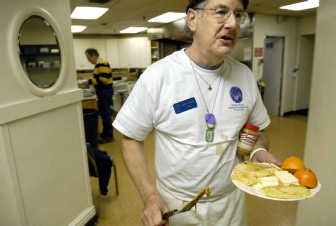
In the church basement, volunteer chef John “Gus” Olsen directs his kitchen crew through the ritual of making pancakes, eggs and bacon for Shalom Ministry’s free breakfast program.
“The recipes really are the same. It’s just that I do everything times 10 or 20,” Olsen says between instructions. “Something smells burned – you still have bacon in the oven, Marshall?”
About 7:30, people start to gather around tables. Olsen’s voice can be heard above the kitchen commotion, asking about somebody’s mother, someone else’s friend.
He’s a huggy person – “tactile,” as he calls it – and for the homeless and otherwise displaced, his warm attention is a rare experience.
Soon, a line forms for breakfast and leftover chicken and pie from a previous lunch.
There are women and men and a few teens, and everyone looks a little sleepy. Some plates shake when they are held out.
“We have as many as 175 show up. That’s the highest number this year, but most days it’s around 40, maybe 70 for Monday dinner,” Olsen says. “It’s up about 40 percent from last year. With the Otis closing and the general discombobulating going on, we’re just seeing more people.”
In a year that saw the closure of the Otis Hotel and other downtown buildings housing low-income residents, programs like Shalom Ministry are more important than ever.
Shalom is part of a national outreach group committed to meeting the basic needs of low-income and homeless people, and creating a sense of belonging for people often seen as outcasts. The program, which has been hosted by Central United Methodist Church since 1994, gets help with funds and volunteers from a few other churches.
Olsen emerged as a homeless advocate in the wake of the downtown housing crisis largely because of his work at Shalom, where he’s been involved for a year and a half. He’s at the helm in the kitchen Monday through Thursday for breakfast and Monday for dinner. He learned of the meal program as a volunteer for St. Mark’s Lutheran Church, one of Shalom’s supporting churches.
This morning’s volunteer crew is David Elton, Marshall Smith and Gary Dyer. They carry on a lively discussion about whether Phil Collins really is a good drummer while Dyer patiently picks meat from leftover turkey carcasses. Olsen laughs as he makes introductions. “This kitchen has turned into a place for wayward males who don’t have anything else to do in the morning,” he says.
Born and raised in Hillyard, Olsen left Spokane in 1963 and didn’t find his way back until three years ago. His 25-year-old daughter, Britta Karen Olsen, lives and works in San Francisco, but his mother still lives in Spokane. Mostly, Olsen says, he returned “for a third marriage that quickly turned into a third divorce.”
The Rogers High School graduate wanted to be a TV news anchor, but ended up going to optometry school in Forest Grove, Ore. Then he headed to Panama as an Army captain.
“I was going to make millions selling glasses and get a big house and a boat and all that stuff. Then I discovered that the kids would come and get my garbage every night and use it for their own dinner. I guess you can say the prince came out of his castle.”
When he returned to the United States, he took a job with Group Health in Seattle, where he worked for 30 years, retiring as clinic chief seven years ago.
In Seattle, Olsen’s drive to help people found many outlets outside of work. He was a court appointed special advocate volunteer for years. He answered phones for a crisis hotline and served as a teen adviser.
“Working for the crisis hotline in Seattle, you actually deal with the person on the other end of the phone, you know, talking them off the ledge of suicide.”
In Spokane, his volunteer service is centered on Shalom Ministry, homelessness and social issues, such as the Task Force for Human Trafficking and Odyssey Youth Center.
Caring for people who live on the fringes of society is a family legacy, he says.
“My grandpa Gus – my mom’s dad – had hobos come home with him in Hillyard when I was little. My mom continued that tradition and my Aunt Mary did, too. My grandfather also gave shelter to abused women who needed shelter, before anyone really knew what that was.”
Grandpa August Olsen owned a small restaurant in Hillyard, made most of his money playing poker and married Olsen’s grandmother, who already had a child.
“At the time, that was unusual,” Olsen says. “Much of what I do, I guess, continues what Grandpa Gus and later my mom did.”
At Shalom Ministry, breakfast patron Virgil Joe smiles broadly when asked what he thinks of Olsen. “I just come here to critique the food,” he says, and laughs. “I was a cook in the Army, and then I spent 15 years at restaurants all over.”
For the past 27 years, Joe has lived in Spokane.
“I’m retired. Weather pending, I come down here often. I’m not homeless or anything, but it’s hard to stretch the Social Security check,” he says. “I come for the companionship. I have no family – so I come for people like John and everyone else.”
Across from Joe sits Walter Denny.
“I come every morning there’s breakfast, and for dinner as well,” Denny says. “You know, $100 in food stamps a month doesn’t go that far.”
Denny walks with a cane since an accident shattered his pelvis. The cold weather leaves him in more pain than usual and sometimes housebound in his fourth-floor apartment.
“I come here for the family-like feel. You sit down for the meal, you have a real plate and real silverware,” Denny says. “When you are being served your food on a tray, it makes you feel like you are at Geiger, you know.”
As the breakfast crowd clears out, Olsen makes a run to Second Harvest Food Bank, which supplies the groceries for Shalom Ministry. The shelves look quite empty this morning.
“Why can we send people to the moon and go fight this war if we can’t feed our own people?” he asks no one in particular, throwing up his hands.
Olsen leaves with a case of bananas, carrots, huge boxes of yeast cake, some yogurt and vegetables cut up for coleslaw.
Back at Shalom Ministry he hoists the 40-pound bag of carrots on his right shoulder, heads down the stairs to the basement and casually says, “I feel fortunate to be able to do this. I had bypass surgery just a couple of years ago. I couldn’t have lifted this much back then.”
And so the conversation goes from whether one can freeze yeast, to the situation in Pakistan, to bypass surgery. Olsen carries on a couple of conversations at the same time – not surprising when one thinks of the activities he’s involved with.
This fall, he worked on former Mayor Dennis Hession’s campaign and became a regular participant on this newspaper’s blogs.
“I like blogging, I really do. It gives me a chance to practice my active listening: Let’s get the feelings out of the way and then we can do problem-solving.”
Almost three years ago, while practicing for Bloomsday seven weeks after bypass surgery, Olsen met Mary M. Carr, dean of instructional services at Spokane Community Colleges.
“A year after that, Mary and I worked together on Barbara Chamberlain’s campaign (for county commissioner) and got to know each other better,” Olsen says about how he met his girlfriend. “Today, we practically live together. We agree politically, but we are also joined at the hip in service in a sense that we are practicing Christians. We do service together; we don’t just sit around and talk about it.”