
Chavez granted broad powers
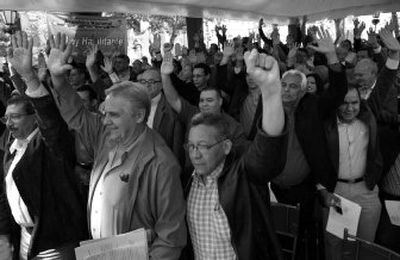
HAVANA – In an unusual outdoor meeting in downtown Caracas, the Venezuelan National Assembly voted Wednesday to give President Hugo Chavez broad powers to accelerate this oil-rich nation’s push toward socialism.
The National Assembly, which is dominated by Chavez supporters, unanimously approved La Ley Habilitante, or the enabling law, which will give Chavez the authority for 18 months to issue decrees in 11 key areas ranging from the economy to defense.
Chavez and his supporters say the new authority is vital to forge a new, more egalitarian economic and social order in Venezuela. Critics say it will speed Venezuela’s slide into authoritarianism.
“The enabling law will turn the Congress into a house of followers and the president of the republic into a dictator,” Eduardo Fernandez, president of the opposition COPEI Party, told the Venezuelan cable news channel Globovision.
But Venezuelan Vice President Jorge Rodriguez told legislators gathered in the Plaza Bolivar that the new law will lay the groundwork for “democracy, peace and, in the end, socialism.”
“Dictatorship is what we had before, a dictatorship of the few,” he said. “Of course, we want to install a dictatorship, the dictatorship of a true democracy. You, us, together (are) building a different country.”
As legislators approved all four articles of the law by a show of hands, National Assembly President Cilia Flores shouted, “Long live President Hugo Chavez! Long live socialism! Fatherland, socialism or death! We will be victorious!”
The lawmakers rose to their feet and applauded.
Since winning re-election in December to a new six-year term, Chavez has announced plans to nationalize Venezuela’s electrical industry and its largest telecommunications company and he has refused to renew the broadcast license of RCTV, the television station most critical of him.
The passage of the legislation Wednesday is likely to worsen the already tense relations between Venezuela and the United States, which have been rocky ever since the Bush administration appeared to back an aborted coup against Chavez in 2002.
Since then, Chavez has denounced the U.S. as the worst terrorist nation on Earth and described President Bush as the devil in a speech last year at the United Nations.
Chavez also has forged close ties to such U.S. foes as ailing Cuban leader Fidel Castro and Iranian President Mahmoud Ahmadinejad, to whom Chavez played host in January.
For their part, American officials have accused Chavez of undermining Venezuelan democracy and destabilizing Latin America.
But the U.S. continues to bankroll Chavez’s revolution by purchasing large quantities of Venezuelan crude oil.
“I’m concerned about the Venezuelan people and I’m worried about the diminution of democratic institutions, as well as nationalization efforts that may or may not be taking place,” President Bush said in an interview with Fox News broadcast Wednesday.