
Mentoring disabled youths
The transition from high school to college or employment is a challenge for anyone. For someone with a disability the transition may seem impossible.
Project MOVE, or Mentoring Opportunities for Vocation and Education, provides support for disabled youths ages 16 to 21 at this critical time in their lives.
Upon graduation, most youths with disabilities lose their support system. According to information provided by Project MOVE, nationally 75 percent of the disabled are unemployed and only 27 percent go onto higher education.
“With lack of community support, they are not transitioning,” Tanya Riordan, equity and diversity initiative director of Community Minded Enterprises, said. “They become isolated, depressed and unemployed adults.”
The primary focus of Project MOVE is to help youths with disabilities move onto employment or secondary education by placing them into a one-on-one relationship with a mentor. Through this relationship, youths are able to explore options and take steps toward their future.
The type of disability does not affect eligibility, and participants over age 21 are considered.
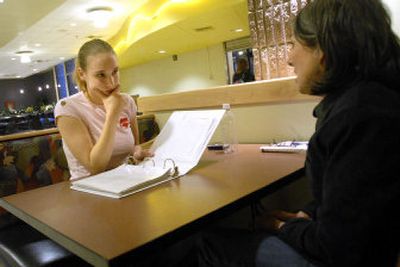
High school junior Crystal Bedeski joined Project Move in April 2005 after the loss of her father. Living with a learning disability, Bedeski struggled with her future. She needed support to fulfill her dream of becoming a registered nurse. After working with her mentor for more than a year, Bedeski sees her future as doable.
“My future without Project MOVE wasn’t going to happen,” Bedeski said. “Now I know what I have to do. I’ve gained the confidence in myself.”
Mentor volunteers must be 18 years or older and enjoy working with young adults. Special skills are not required only the willingness to spend a minimum of two to four hours each month for a year. A year commitment is preferred to give time for the relationship to develop. Mentors offer encouragement and guidance, not problem solve.
“It’s less about helping a person,” Riordan said. “It’s more about simply being there for a person, listening and sharing.”
“It’s not as difficult as people might think,” said Debbie Baril, who joined Project MOVE as a mentor in June 2005. “We’ve all transitioned, and sharing our life experiences can help. It doesn’t take a lot of time and you’ll make a big difference in someone’s life.”
Project MOVE, funded through a five-year grant from the U.S. Department of Education, Rehabilitation Services Administration, is a collaborative effort among four different agencies. Washington Initiative for Supported Employment coordinates the mentor/mentee matches. University of Washington conducts the research and evaluation for the project. Big Brothers and Big Sisters of the Inland Northwest provide support and Community-Minded Enterprises facilitates the funding, public relation and recruitment outreach efforts.
The mentor/mentee match process is adapted from the Big Brothers and Big Sisters approach, used by an organization renowned for its one-on-one community-based mentoring programs. The mentor and youth go through a series of questions and interviews to determine a match based on interests, abilities and preferences. Both the youth and the mentor require background checks. “The matches are done in a conscientious manner,” Riordan said. “It’s a mutual process where both the youth and mentor select each other based on common interests and desires. We match individuals who are compatible and will hopefully sustain a relationship over a 12-month period.”
The benefits of a mentoring relationship are tremendous for both the mentor and the youth. Research shows that mentors have a greater sense of civic pride and increased confidence and effectiveness. Young adults gain increase knowledge of skills and abilities, overcome feelings of isolation and gain a sense of self-confidence.
Alisha Presson, 18, struggles with a learning disability. Since joining Project Move in June 2006, she says she has gained more confidence.
“Project MOVE has really helped me clarify what I want to do,” Presson said. “They really try to help you, and they don’t quit.”
Project MOVE is a research project. The University of Washington conducts research evaluating the effectiveness of the program. “We will know at the end of five years what works and what didn’t work,” Riordan said.
The key barrier Project MOVE must overcome is the presumption people with disabilities are unemployable.
“There are social assumptions about their ability to carry out a job or go onto school that is harming their future.” Riordan said. “They really need to see themselves as capable individuals with gifts and talents because they are.”
“It’s easy; give it a try,” Baril said. “It doesn’t take much time and you can impact someone’s life. These kids need our help and all you need to do is be there to support them.”