
Raising American lowlines
When Chris Snow’s youngest child was 6 months old, her husband Dean came home with a startling announcement. “Guess what I just bought?” he asked, and before she could reply, he blurted, “Five cows!”
Chris Snow did what many women would do. She burst into tears. As a busy mom of four she knew what would happen. In addition to the kids and a variety of pets, she’d get stuck taking care of cattle. So Dean delayed the purchase of the cows, for the sake of family harmony and regular meals. “She’s a good cook,” he said with a smile.
But the delay only lasted six months. The Snows were then living on five acres near Sacramento and had looked into buying livestock for tax purposes. That’s when they discovered American lowline cattle. Developed in Australia from Angus stock, this diminutive breed is 30 percent smaller than their larger cousins. In 2002 Dean brought the minicows home.
“They only get to be about 4 feet high at their tallest,” said Chris Snow. Their size makes them perfect for smaller properties, because they eat less and take up less space than traditional cows.
In 2004, the Snows, tired of the hectic pace of life in California, loaded up their belongings, their various pets, and their five American lowlines, and moved to 33 acres they’d purchased near Medical Lake. It took quite a convoy to get them all here. “We looked like a traveling circus,” Chris Snow said.
Three years later, the original herd has grown to 14, including two calves born this winter. Minicattle weren’t created to be pets. They were developed to be bred for beef, but their size and gentle disposition are making them a growing choice as pets for small-property owners. “They’re not ‘house-cows,’ ” Chris Snow said. “But they’re very docile, social creatures.”
On a recent afternoon the herd gathered around her when they saw her coming with the treat bucket. The alfalfa cubes don’t look very appealing, but the bovines seemed to enjoy them. “They’re very easy to tame,” she said. “Shake the bucket and they’ll come running.”
Solomon, the lone bull, ambled up to the fence to great guests. His breath clouded in the winter air. He appeared to be in dire need of a tissue as long ropes of mucus dangled from his nostrils. “That’s what his tongue is for,” Dean Snow said. And sure enough, Solomon wiped his own nose … with his tongue.
Five-year-old Caleb Snow is more interested in toting the barn cat around and jumping off hay bales. “They’re still a little bit big and intimidating for him,” said Chris Snow, pointing at the cows.
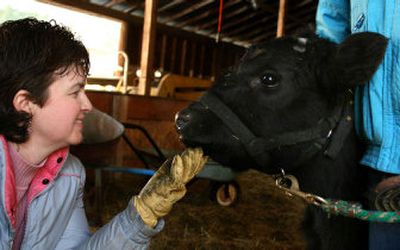
Emily, age 14, has taken on the role of ranch hand now that 19-year-old Levi has left home. She had her hands full as she worked in the barn with Suzie Q, a newly weaned 5-month-old cow. “We’re trying to halter break her,” she said. Her younger sister Missy added, “The little babies are my favorite.”
Though the Snows seem adept and at ease with their herd, Chris Snow said, “Neither of us were raised as ranchers. We’re learning as we go.”
Dean works full time as a project manager for Crescent Electric in Spokane. “This is my night and weekend in job,” he said. The family sells most of the cattle for beef.
In addition to home-schooling three children, Chris handles all the paperwork for the farm. As she returned from the pasture with an empty bucket of alfalfa cubes, she laughed as she remembered what she calls Dean’s famous last words, “You won’t have to do anything with the cows!”