
Indians get support in SCC fight

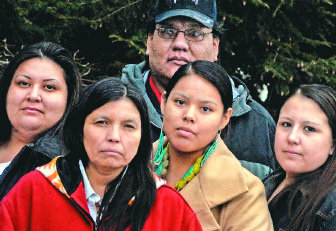
A group of American Indian students has asked for the support of the community and area tribes in their struggle to reclaim a student club at Spokane Community College that they feel has been taken away from them.
An SCC vice president said she has done all she can to appease the students, offering to let them join the Native American Student Organization (NASO) or form a new club of their own.
But the students — perhaps a dozen enrolled members of area tribes — are far from being appeased. They accused the school’s administration of “institutional racism.”
One of their leaders, Bernadette Agapith, likened her group’s treatment at SCC to “being put on the reservation and told to deal with it.”
During a meeting Wednesday evening at the Spokane Public Library, Agapith’s group appeared to have won some community backing, including that of two members of the Tribal Business Council of the Confederated Tribes of the Colville Reservation.
“We came here to help,” said Councilman Lee Adolph, who was accompanied by fellow council member Brian Nissen. “We should have been here last fall.”
The students’ problem with administration began at the start of the school year when they were informed that a non-faculty SCC staff member, who had advised the Native American Student Organization for nine years, had been replaced with a faculty member unknown to the Indian community.
Under terms of their contract, faculty members have priority in choosing to be student club advisers. The students said this contract favors a faculty that is overwhelmingly non-Indian.
In November, the students were prevented by school officials from protesting an on-campus Indian taco sale held by the club under the new adviser. In December, student leader Anah Tomeo wrote Gary Livingston, chancellor and CEO of the Community Colleges of Spokane.
Livingston responded that he would let SCC president Steve Hanson and Terri McKenzie, vice president of student and instructional services, handle the matter.
“I agree with the SCC administration that this is a college and student club issue …,” Livingston wrote.
On Thursday, Livingston maintained that position, saying it would be inappropriate for him to intervene.
“To not handle it at the college level would diminish the chance of reconciling the issue,” Livingston said, adding that the college has spent “much time and energy” on diversity.
On Jan. 8, the protesting student leaders met with McKenzie to resolve the issue.
But when a leader’s mother and grandmother, Deb and Anita Abrahamson, showed up to support the students, McKenzie stopped the meeting until the elders left.
“She called me ‘an activist,’” Deb Abrahamson, a Spokane Tribal member, said. “If they are accepting funds from our tribes, they have a responsibility to respect us. When education becomes painful, we have a right to stand up for our children.”
McKenzie said she is sorry Abrahamson was “portraying the meeting as being kicked out.” She said she was not prepared for a “community meeting.”
“Part of our involvement is to direct action toward students so they can be responsible adults,” McKenzie said.
Livingston echoed that position.
“This isn’t K-12,” he said on Thursday. “These are adults.”
Nevertheless, turning away tribal elders from a meeting involving their children would be considered disrespectful in most tribal cultures.
“They spit in the face of that core cultural value,” said Martina Whelshula, an enrolled Colville and president of the Spokane Tribal College in Wellpinit, a branch campus of the Salish Kootenai College.
Whelshula, who also is Tomeo’s mother, called the administration’s handling of the Native students “an abuse of power” and “disenfranchisement.”
McKenzie said there are two groups of students involved, the current NASO members, many of whom claim Native American ancestry, as well as the protesting students. She said the current members met with the protesters but were unwilling to meet their terms for membership in NASO, including new elections of officers.
Other terms of the protesting students and McKenzie’s response to them include:
“Money allocated to NASO at the beginning of the school year.
The students said it amounted to about $5,900, based on last year’s budget. McKenzie said she was willing to work with the students, but so far she has only offered $300.
“An adviser of the students’ choosing, even if it means changing the faculty contract.
McKenzie said contract negotiations are not for “a couple of years,” but that she has made a request to SCC’s human resources director to include the issue in negotiations.
“Cultural sensitivity training for all faculty, staff and administration. McKenzie said the SCC Diversity and Equity Council has already met to look into such training. “It’s something we are doing on campus, anyway,” she said.
“We have invited the students a number of times to let us help them resolve this,” McKenzie said. “They have everything they need to start their own club.”
Also present at Wednesday’s meeting in the library was Glen Douglas, a decorated combat veteran who pledged $500 from his recent Indian boarding school settlement with the Canadian government to help the students form their own club.