
Honda makes a good CR-V superb
Honda violated the first two principles of the Universal Automakers Makeover Mantra with the redesign of its popular CR-V crossover SUV.
The Makeover Mantra goes: “Bigger. Faster. Better.”
This time around, Honda nailed better, but only nodded toward faster and skipped bigger altogether.
It’s not an oversight: Owners tell Honda they like the size of the CR-V. They say they want a vehicle that’s comfortable, practical and easy to park.
They’re not clamoring for third-row seating or bunches of more power, so Honda gives them neither.
What owners do get this year is a more stylish, refined, safer and better-equipped CR-V.
Prices for front-drive models start at $21,105; AWD starts at $22,395.
A Stylish CR-V
The first-generation CR-V succeeded in spite of its boxy, utilitarian appearance.
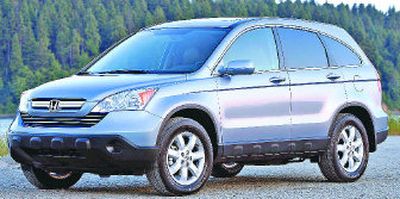
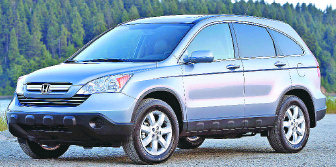
The new one is stylishly ovoid. Its rounded front-end is highlighted by a new two-tier grille; the roof-line flows in a graceful arc, though the ever-practical Honda designers tapered it into a level surface toward the rear to preserve rear-seat headroom and cargo space.
Meanwhile, the window line breaks downward into a fat C-pillar. It’s unorthodox, but it’s not boring.
And because their goal was a hipper CR-V, designers allowed themselves the indulgence of a touch of lower-body cladding.
The overall shape is more aerodynamic, improving fuel-efficiency and reducing wind noise.
No Pretense to Luxury
Interior design is typical Honda – neat, well arranged and understated. Warmer than before, it combines metallic-look vertical surfaces with softer horizontal panels finished in attractively grained plastics. The approachable, quality-oriented design offers no pretense to luxury, though the leather-lined interiors of the up-level trims nearly rival those of the entry-luxury class.
The controls have the feel of well-machined switchgear and the gauges and control panel are logically arranged and easy to use.
The shift lever, formerly housed high in the dash, has been moved to a more conventional location below the center instrument stack. A tilt-and-telescoping steering column is added this year, making it easier to find the ideal driving position.
The front seats are well contoured and comfortable, though they lack adjustable lumbar support and are not available with power controls.
Safe, Parent-friendly
Rear-seat legroom is outstanding, a benefit of the decision to forgo a third row. The CR-V is equipped with LATCH child-seat systems and the rear doors open to 90 degrees, making life easier for those responsible for buckling in the youngsters. A series of detents prevents the doors from closing unintentionally.
A nifty system of folding and sliding rear seats lets parents move children forward for what Honda calls improved “communication,” but which grateful adults will recognize as better opportunity for control.
A “conversation” mirror, built into a sunglasses holder, offers an unobstructed view of the rear cabin.
Noise, vibration and harshness are noticeably reduced this year and cabin safety gear includes a full set of airbags, including curtain-style bags and dual-stage, dual threshold front bags. Front seats incorporate anti-whiplash technology.
Anti-lock brakes, with electronic brake-force distribution, and vehicle stability and traction control systems are also standard.
A Familiar Platform
You wouldn’t know it to look at it, but the CR-V rides on the same platform as the compact Civic, and its wheelbase is 2 inches shorter than that of the Civic.
Honda trimmed 3 inches from overall length by relocating the spare from the tailgate to a well beneath the cargo floor. The CR-V is now 2 inches longer than a Ford Escape, 3 inches shorter than a Toyota RAV4.
The structure is more rigid than before, allowing engineers to better tune the suspension. The ride and handling package is more compliant now over rough surfaces and less prone to body lean in fast corners. The CR-V is stable in quick transitions and within its limits can be entertaining to drive.
The electronic, full-time all-wheel-drive system uses sensors to detect wheel slip. In tandem with the standard vehicle stability control system, it shifts torque to the appropriate wheels to help prevent spins on slippery surfaces.
The system works not just front-to-rear, but also side-to-side, to help offset both oversteer and understeer.
Rollover sensors can detect the type of impending rollover and take whatever evasive and/or preparatory measures possible.
Output from the CR-V’s iVTEC 2.4-liter four is up this year — horsepower by 10, to 166, and torque by 1 pound-foot — though fuel efficiency remains the same. Unlike its prime competitors, which offer six-cylinder options, the CR-V has only the four.
The CR-V is quick enough for angst-free freeway merging, but drivers may wish for more power when passing.
The 2007 CR-V proves that a vehicle built right the first time doesn’t need to be reinvented the next time around. Owners of the first-generation CR-V told Honda they love their rigs and Honda gives back the love with a better version of what already was a good thing.
Like rules and records, it appears mantras are made to be broken.