
Safety agencies feel deployments

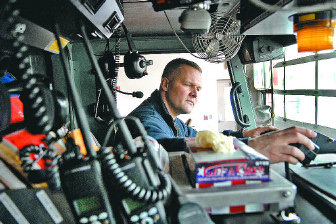
As the president’s call for a troop surge in Iraq flashed across the TV, many National Guard or Reserve families already were watching from a table with an empty seat.
The cost of war is obvious in some ways. But the effect of military deployment on a community can be as subtle as the empty chairs at a police or fire department meeting table. It’s also felt in the budgets of fire and police agencies throughout the Inland Northwest.
Right now, the Spokane Valley Fire Department seems to be getting hit harder than most, although many other agencies – including the Idaho State Police and Spokane Police Department – have felt the pinch at times, and likely will again.
“It’s just had more of an impact on everybody in the last years, considering the conflict that’s going on,” said Spokane Valley Fire Chief Mike Thompson.
By May, five of Thompson’s 148 firefighters will be gone on 18-month deployments, their service decided well before a recent push by the Bush administration to send 21,500 more soldiers and Marines to Iraq.
A special levy last year allowed Thompson some leeway to hire a couple of additional recruits later this year to fill the gap. In the meantime, additional absences due to illness or vacations have to be made up with expensive overtime.
“Between now and the end of May we are very short,” Thompson said.
While Guard members and reservists work in many sectors of business and government, public safety agencies often seem particularly attractive to those in the military world who start civilian careers.
Work in the military involves a culture of camaraderie, sacrifice and service.
“You pretty much get the exact same thing at the fire department,” said Valley fire engineer Don Kresse, who flies a Black Hawk helicopter for the Army National Guard and leaves soon for the Middle East.
When Kresse and others are called to put community service on hold for service to the nation, federal law guarantees their jobs are waiting when they return. Getting back to work, though, involves a lot more than just switching uniforms.
Returning service members also have to spend time catching up on the latest training and procedures for positions like paramedics.
“The only true standard in medicine is that things change,” said Spokane Fire Department Assistant Chief Brian Schaeffer.
“When people come back after a year of separation from a job like this, it’s not just relearning how to be a paramedic,” he said.
His department has four firefighters currently deployed, which has been the norm for a couple of years. That hasn’t meant much overtime because of the way the department shifts work, but Schaeffer said every expense and every absence affects the department.
“If that seat isn’t filled it does have an impact, a daily impact when we look at our daily staffing,” he said.
A smaller contingent from the Spokane Police Department also has served in recent years, but no one is gone right now, said police spokesman Cpl. Tom Lee.
At the Spokane County Sheriff’s Office, about a half-dozen people have been deployed and returned, said spokesman Sgt. Dave Reagan.
Like other public safety agencies, the county has handled the absences by hiring new people to replace them.
“That’s a long time to do without,” Reagan said. When the Guard member or reservist returns, “we just hope, through attrition, that someone has retired or quit,” he said.
As the director of the Idaho State Patrol made the case for more officers to the Legislature in 2005, an estimated 8 percent of troopers had been deployed.
The Coeur d’Alene police had one officer serving in Iraq. The department was able to handle the extended absence the same way it deals with personnel gone because of illness or other reasons, said Police Chief Wendy Carpenter.
But sometimes even one person in an organization can have a huge effect on how things get done.
“Pretty much around here, if it plugs in, I take care of it,” said Greg Bingaman, the sole, full-time computer expert for the city of Spokane Valley.
He’s also a longtime Navy reservist who serves as a photojournalist for military publications, most recently during a three-week deployment to Sri Lanka, where the U.S. military offered aid to victims of the 2004 tsunami.
Being called up again is always at the back of his mind.
“It would have a huge effect on the city’s ability to have a continuity of service,” said Bingaman, who manages the city’s computer servers, planning software and information technology.
In fact, Bingaman said, the disruption an extended deployment could cause his family and the city concerns him more than the possibility of being sent to war in Afghanistan or Iraq.
“I’m in the military for a reason,” he said. “To serve my country.”