
Skinny herd too big for habitat
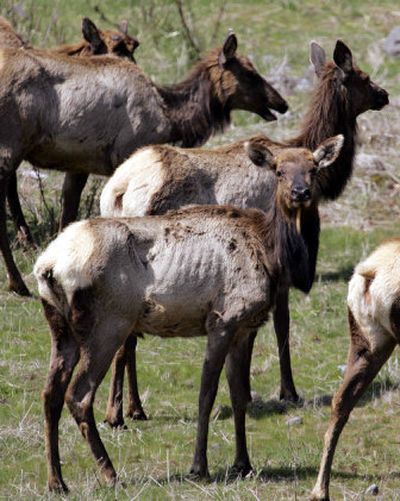

MOUNT ST. HELENS, Wash. – Hay trucks are arriving daily this winter at the Mount St. Helens Wildlife Area near Toutle, bringing fresh alfalfa to wild elk like so many cattle in a feedlot. It’s a last resort for state game managers, pulled by science in one direction and public sentiment in another.
There are too many elk in this herd for their depleted habitat. So now the state Department of Fish and Wildlife has decided to feed this herd to get it through winter – then schedule special hunting seasons to thin the herd by 2,500 within five to eight years.
On its own, this herd would slowly come into balance with its habitat. Up to 15 percent would starve, freeze or be eaten by predators over the winter.
But nobody comes to the nearby visitors centers and highway overlooks to peer down at the state’s largest elk herd and see them dead or starving. The animals are also worth about $30 million to the local economy come hunting season, according to government estimates. So, to some, just letting nature take its course seems a waste.
Department director Jeff Koenings approved the first-ever feeding of the herd this month, adding it to the roster of elk already fed around the state under a controversial policy under way since the 1960s. The state will spend $820,000 this season feeding elk, the most ever by far, because of harsh winter weather conditions on both sides of the mountains.
Yet feeding elk is not without risk or ill effects.
It brings large numbers of elk nose to nose, raising the chances of spreading disease. And it also can make ordinarily wild animals tame and dependent on the dinner bell. More fundamentally, feeding changes the equation of how many animals the habitat can sustain.
The larger question here and elsewhere is how many elk can be kept in habitat degraded by development, dams and logging practices without turning the herd from wild animals into amusement-park attractions.
“Whether to hunt them, or to watch them, people want to see more of them, they don’t care about the biology,” said David Ware, manager of the wildlife division of the department. “Public sentiment is `We want as big a population as we can have. We want to see more, hunt more. More, more, more.’ “
This conflict between the needs of elk and the humans who love them plays out not only at Mount St. Helens. Elk are munching golf courses in Cle Elum, Kittitas County, and roses in North Bend and crashing through retirees’ gardens in Clallam County.
Keeping everyone happy – suburbanites, hunters, farmers, tourists and wildlife watchers – is also expensive. Game managers build fences at a cost of up to $100,000 per mile to keep elk where folks think they belong. They move elk from place to place at $1,000 per animal. The state has paid out more than $888,000 over the past five years for elk-damaged fences, farms and other property. And the Fish and Wildlife Department is sustaining more elk with feeding programs.
“Elk are very popular for viewing and hunting, so in a lot of places the department is directed to maximize recreation,” Ware said.
“I don’t disagree. We are a public agency, we have an obligation to do what the public asks us to do. It’s nice, it’s fun that people enjoy wildlife the way we do. But the challenge with a growing human population is wanting to keep wild things wild. There’s an enormous conflict there.”
The eruption of Mount St. Helens in 1980 effectively clear-cut about 230 square miles in the herd’s habitat, some 4 billion square feet of standing timber. It was good news for elk, who thrive on elderberry, trailing blackberry, and the other browse of open areas.
The elk population grew to numbers that probably exceed the populations that existed before American settlers arrived in the 1800s. Back then, unbroken stands of dense forest meant elk were sparse and even absent over large areas.
After settlement, elk populations here were nearly wiped out by hunting, so game managers brought in Rocky Mountain elk at the turn of the 20th century.
Today the goal of game managers isn’t building elk numbers but thinning the St. Helens herd to keep down the complaints of people who don’t like their gardens munched, and to get the elk within naturally sustainable numbers.
The use of herbicides instead of fire to clear private timber land has shrunk the food supply for the elk. So have Forest Service limits on logging, which have led to denser forest stands that shade out open areas.
Development along the roadsides and river drainages has bitten into elk habitat. The riverbanks of the Cowlitz and Lewis rivers, formerly excellent winter range for the St. Helens herd, have been drowned by dams.
With a hard winter under way this year, wildlife managers saw a repeat of last winter when some 60 elk in this highly visible herd died. Hunters wanted at the struggling elk. Other people wanted them fed.
“Picture your phone ringing every five minutes,” said Brian Calkins, the manager of the Mount St. Helens Wildlife Area.
For now, the wildlife managers say they want to feed the St. Helens herd this winter only. But it can be a hard thing to stop, once begun.
“People want to make a pet, or take each individual animal to a zoo rather than let nature take its course,” Ware said. “We don’t want nature to mean animals eating each other, or dying when their numbers are too many.”