
A campaign starts; the honeymoon ends

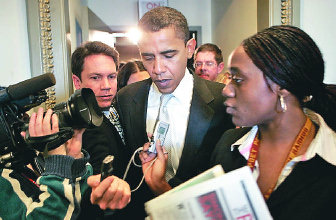
WASHINGTON – After formally announcing his presidential quest in Springfield, Ill., today, Sen. Barack Obama will embark on a grueling, nationwide quest that will test the depth and endurance of his instant celebrity.
Up to now, Obama has largely avoided scrutiny in an orchestrated climb fueled by a compelling personal story and abundant raw political talent.
But during a three-day, six-stop campaign swing after Springfield that will take him to Iowa, Chicago and on to New Hampshire, Obama likely will begin facing questions about his scant experience, his inconsistent message and the legitimacy of his claim to be an “outsider.”
He also might have to get used to manure on his shoes.
“Not too many politicians know what it’s like to get up in the morning after sleeping in a small-town motel in Iowa, it’s 10 below zero and you have to be in somebody’s barn at 7:30 a.m.,” said Bill Carrick, who managed former Rep. Richard Gephardt’s campaigns for the Democratic nomination in 1988 and 2004. “If you don’t have discipline and can’t hit the ‘on’ button fast, you’re in trouble.”
Like other Democratic strategists, Carrick marvels at the trajectory of Obama’s rise, unmatched in modern American politics.
By the same token, they warn that what lies ahead for him is brutal and incalculable, a challenge even more daunting than in past primary seasons because of the strong field of aspirants and a front-loaded primary that might already have produced the Democratic nominee a year from now.
For Obama – or for New York Sen. Hillary Clinton or former North Carolina Sen. John Edwards – that means winning early after raising enough money, well over $50 million, to compete in as many as 30 caucuses and primaries by February 2008.
Martin Frost, a former Democratic congressman from Texas and longtime political operative, said the odds are against Obama. He noted the early successes in the presidential quests of former Colorado Sen. Gary Hart in 1984 and Gephardt in 1988, campaigns in which he was involved. Both failed, and each blamed lack of money.
“The biggest problem is going through the meat-grinder,” Frost said. “It is a different ballgame. You’re playing at a different level. I don’t care who you are. … When you run for president, it is a game with different rules.”
Independent pollster Del Ali gives Obama a 50-50 shot at winning the nomination. He said that he is struck by Obama’s appeal to Democratic activists, many of whom “don’t want to hold their nose as they did with John Kerry and Al Gore in ‘04 and 2000.”
Ali said Obama has a huge issue in his favor when stacked up next to Clinton and Edwards: his early and unequivocal opposition to the Iraq war. Clinton and Edwards both supported the resolution giving the president the authority to invade Iraq.
“Iraq is the main issue in the campaign,” said Ali, who has polled for the Post-Dispatch and other news organizations.
People mesmerized by Obama’s stentorian voice will be listening more closely now to his words to see what adds up and what doesn’t.
For instance, at the Democratic National Committee’s recent winter meeting in Washington, some of Obama’s speech appeared to endorse rhetoric over substance. “They say, well, we want specifics, we want details, we want white papers, we want plans,” Obama said. “We’ve had plans, Democrats. What we’ve had is a shortage of hope.”
Yet Obama has criticized the White House for insufficient planning in Iraq and his own position on war is rooted in a detailed plan that would remove all combat brigades from Iraq by midnight, March 31, 2008.
Obama will be facing increasing pressure to get beyond spiritual rhetoric about hope in order to keep up with the likes of Edwards. A more experienced politician who has led in early Iowa polls, Edwards proposed a plan for universal health care last week with the blunt admission that it would cost $120 billion and require a tax increase.
In discussing Obama’s liabilities, people speak more of his inexperience than his race.
But without question, race will be a prominent subtext to his candidacy, and Obama’s skill in handling the questions will be among keys to his success.
Charlton McIlwain, a co-director of New York University’s Project on Race in Political Communication, said he believes the challenge for Obama will be overcoming stereotypes of African-American candidates as running only on behalf of other blacks.
Polls show Obama has put himself in a position to succeed. His favorable ratings are roughly equivalent to other White House hopefuls, but far more voters have no opinion of Obama than of other contestants because they don’t know him.
“He has the ability to first attract a crowd and then to fire them up in ways I’ve never seen in another politician,” said Illinois Sen. Dick Durbin, a fellow Democrat. “His message is refreshing and new, and the people who show up at his events are not just the party faithful but new faces. …
“When it’s all said and done, I think he can be the nominee. Regardless, he’ll engage people that otherwise would not have been in the process,” he added.