
Don’t be fooled by new beacons
A Spokane woman who skied with a snowcat guide service recently was impressed with the latest technology being used in avalanche transceivers.
“These things are so easy to use,” she said. “The guides told us that nowadays they spend more time teaching people how to use shovels than they do the new digital avalanche beacons.”
Transceivers are essential gear that should be worn by everyone in a party traveling into avalanche terrain, regardless of whether they are skiing, snowshoeing or snowmobiling.
This is a commitment, considering that each unit costs about $300. But if an avalanche occurs and buries members of a party under snow, survivors can turn their units into the “receive” mode and search for the victims wearing units that are still transmitting locator signals.
The newest transceivers are cool — some costing as much as $600 — with LCD readouts, menus and arrows that help indicate the direction you should be looking.
But hearing that guides are spreading the notion that they are easy to use was unsettling to Shep Snow, a Sandpoint snow safety expert who teaches avalanche avoidance classes.
“That’s crazy,” he said, taking a break from waxing skis for junior racers he coaches at Schweitzer. “I spend hours and hours in classes showing people how to use transceivers and the last thing I tell them is to keep practicing because you don’t want to be the person who goes two years without using one until suddenly your sister is buried in the rubble of an avalanche.”
According to Snow, details that need to be studied include:
•Flux line – Signals from transmitting beacons do not disperse in all directions at equal strength, but rather in a three-dimensional “flux line” pattern that looks like butterfly wings radiating out from the victim when diagrammed on paper.
Beacons that use digital processing to give distance and direction information DO NOT always point the user directly at the transmitting beacon. They give the information based on the flux line, which may lead searchers away from the victim for a short distance before looping back to the source of the signal.
“It takes practice to do a flux line search,” Snow said.
•Search radius – “Transceiver packaging might boast that it has a search radius of 50 to 80 meters, but that’s B.S. because that means at room temperature with fully-charged batteries and optimum alignment of antennas.”
Referring to the case studies in “Snowy Torrents: Avalanche Accidents in the United States,” Snow said victims have been missed because searchers were walking down the middle of 50-meter-wide avalanche paths thinking they were covering the entire area “when in fact they were only covering maybe 13 to 18 meters,” he said.
“Some manufacturers are necking down their radius claims. Before we go backcountry skiing, we do a radius check on everybody’s transceiver, and they always vary. We note the smallest radius and that’s the radius for our group.”
•Multiple burials – “About 80 percent of the time, a two-person burial search goes well, but a triple burial can be very difficult with some digital transceivers, most notably the Tracker,” Snow said. “Some of the newest models have multiple-search modes to help eliminate confusion.
Snow said he is impressed with modern avalanche transceivers but wary of how people put blind trust into technology.
“I teach rescue seminars to snowmobilers because they don’t want to hear about changing their habits,” Snow said. “They are notorious for buying the best gear and not knowing how to use it and then going into really dangerous terrain.
“I commend those who take the time to take a course. The last snowmobilers I had were in shock at how much they learned.
“And just last Sunday I was teaching a guy with 20 years of backcountry skiing experience. We went through the transceiver thing and when we were done, he said, ‘God, I never knew all of that.’
“The bottom line is that these are great tools that can fail because of operator error,” Snow said. “People don’t realize how little they know until their best buddy dies.”
Generally, digital transceivers are easier to learn how to use and can speed searches, Snow agreed. However, experienced searchers can be just as fast with analog transceivers, which can be easier to use in multiple burials while providing longer battery life and a longer search range.
Some models made by Barryvox and Ortovox have an analog mode to increase search range while allowing users to switch to digital mode when about 10 meters away to take advantage of digital’s better pinpointing qualities.
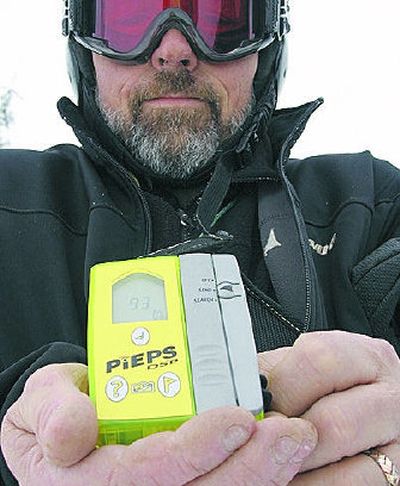
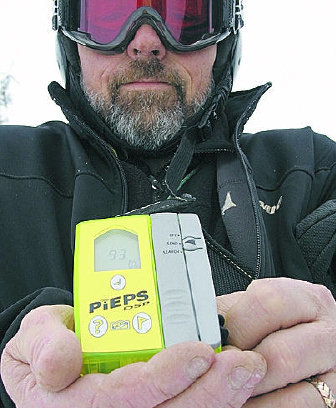
Snow, who sometimes guides backcountry skiers, chose the Pieps DSP for its various functions, including its multiple burial mode.
Also getting good reviews from experienced backcountry skiers is the Ortovox M2, an analog beacon with many special features, such as indicating signal strength, when the antenna is lined up with the flux line, and distance (along the flux line) to the transmitting beacon.
The pros and cons of transceivers ultimately are most important to the person who’s buried by an avalanche and clinging to life under the snow.
In other words, after evaluating the features of beacons in your group of winter backcountry travelers, if one model truly is easier to use, give it to your partner.