
Empty streets
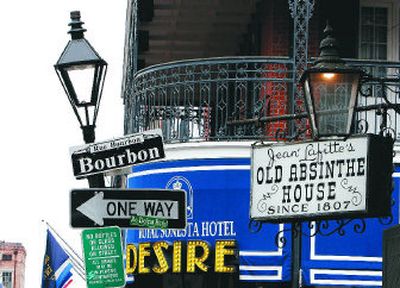

NEW ORLEANS – The hookers are back on Bourbon Street. So are the drug dealers, the strippers with names like Rose and Desire, the out-of-town businessmen, the college students getting blitzed on candy-colored cocktails and beer in plastic cups. But a closer look reveals things are not the way they used to be in the French Quarter. A year and a half after Hurricane Katrina, New Orleans’ liveliest, most exuberant neighborhood is in a funk.
“The money’s not the same. I remember when I made $1,200 a night,” says Elizabeth Johnson, a manager and dancer at a Bourbon Street strip club, frowning at another slow night.
“I know girls who used to never let people touch them, and now they’re resorting to prostitution.”
Robert Boudreaux, a beefy hotel bellman in an olive green vest, scans the street with folded arms and says: “Very boring.”
The Quarter still has its characters: palm readers, magicians, street musicians, mimes.
But the cheap fun is largely confined to the weekends these days, and seven-day-a-week stores, restaurants and clubs such as Preservation Hall are cutting back on their hours. The nonstop party is no more.
The “cams” – real-time camera footage of Bourbon Street, shown over the Internet – are dull on weekdays. Dixieland bands play to empty barrooms.
“The Quarter rats are drunk and high still, but they’re less drunk,” says bartender Dawn Kesslering.
In the Lower Quarter, the district’s residential half, where people walk poodles and neighbors share clothes lines in galleried courtyards, old-timers do not see as much zest around them.
“It’s become far more homogeneous, far more middle-class than working-class,” says John Dillman, who sells used books. “It will look like Boca Raton. A version of Boca Raton that has risque.”
In 2004, the last full year before Katrina struck, about 10 million visitors came to New Orleans, most of them drawn by the French Quarter. In 2006, just over 5 million arrived.
“Every time they’d see CNN, Fox, they’d show flooded streets. Everybody thought there was nothing to come back to,” says Earl Bernhardt, owner of several Bourbon Street nightspots.
In truth, the French Quarter was largely untouched by Katrina’s fury. But it suffered financially anyway.
Businesses are pressing city and state officials to promote the Quarter more. Without the tourists, even Mardi Gras, which falls on Feb. 20 this year, will do little to balance the books at many businesses.
Some nightspots really are gone, such as O’Flaherty’s, an Irish pub known for its soul-warming reels and TVs tuned to World Cup soccer.
Bella Luna, La Madeleine and the Old New Orleans Cookery – popular eateries – fell victim to Katrina. The Little Shop of Fantasy, a Mardi Gras mask shop run by two sisters, cleared out of the Quarter and went online.
And after 83 years, Hurwitz Mintz shuttered its flagship furniture shop on Royal Street.
Since Katrina, the real estate market has been in flux, and rents have gone through the roof because of the overall shortage of housing in New Orleans.
“I’m paying the most rent I’ve ever paid, and I’ve got the smallest place I’ve ever had,” said Bob Clift, a portrait artist who waited in vain one recent day for customers under the live oaks on Jackson Square, outside St. Louis Cathedral.
A familiar face in the Quarter for 37 years, Clift said he is planning to leave the city after paying about $1,000 a month for an 8-by-15-foot room.
“Poor people can’t live here anymore,” he said. “Including me.”
Hollywood power couple Brad Pitt and Angelina Jolie can afford it; real estate records show they bought a house in the Quarter for $3.5 million on Jan. 2. The couple have a history with New Orleans, having helped to raise awareness of the hurricane’s devastation.
After Katrina, waves of hurricane refugees and looters filled the French Quarter’s streets. Then soldiers in red berets and boots took Bourbon Street by storm. Then came the journalism corps, construction workers and prostitutes.
But now it is so quiet, many people feel afraid to walk the streets at night.
Because of a spate of robberies, some stores and bars are locking up early. Several street shootings, a fatal stabbing and a grisly murder-suicide have put residents on edge.
“I’m taking gun classes now,” says Mary McGinn, who works for a French Quarter real estate agency.
She says she hit her head on a concrete step after a mugger knocked her down Aug. 18 outside her home. It took 35 staples to close the gash.
“He got $60. Whoop-de-doo!” she says, smiling gamely in a neck brace.
Police blame the spike in crime on the storm.
“Some of these areas the criminals used to hang out in aren’t there anymore, so they’re coming down to the French Quarter,” says Capt. Kevin Anderson, the Quarter’s police commander.
But he insisted the Quarter is safe, largely because there are 45 more officers on patrol than before the storm. And he said crime is down from 2004 in all categories except assault.
“We’re dealing primarily with a perception problem,” he says. “When someone gets shot in the French Quarter, it’s not just national news, it’s international news.”