
Peanut butter illness hits home
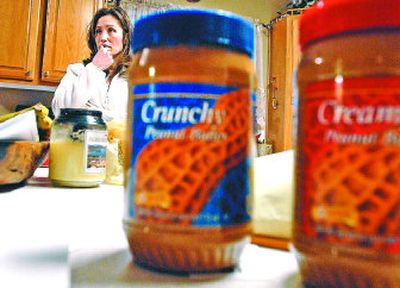
Families searched their cupboards, and stores pulled certain jars of Peter Pan and Great Value peanut butter across the Inland Northwest on Feb. 15 after it was linked to a salmonella outbreak that has sickened nearly 300 people nationwide.
Two Spokane adults were among four confirmed cases in Washington of a rare strain of the bacteria linked to food-borne illness affecting people in 39 states, health officials said Feb. 15. It was not clear whether they’d actually consumed the affected peanut butter.
Dozens of other residents, however, called the Spokane Regional Health District to report they’d become ill after eating from jars of those peanut butter brands marked with the product code beginning “2111,” said Mark Springer, a staff epidemiologist.
“Starting this morning, we’ve had a number of calls looking at symptoms over the last month or two,” Springer said. Those include fever, diarrhea and abdominal cramping.
Even in Idaho, which was not among states linked to the illness, families cast a queasy eye on large jars of chunky and creamy peanut butter produced by food giant ConAgra at a processing plant in Sylvester, Ga.
“I saw that and it kind of freaked me out,” said Jim Hoffman, 40, a Coeur d’Alene father of three who bought 4 pounds of potentially tainted Great Value peanut butter at a Post Falls Wal-Mart the previous week. “You see this stuff and you think it’s somewhere else, not here.”
Hoffman said he and his 9-year-old son Devon, became ill after eating the peanut butter, but they just thought it was a passing stomach bug. After hearing about the peanut butter scare, they called their family doctor and were still waiting to hear whether they needed to be tested.
Officials at the Panhandle Health District had received no reports of illness from doctors, said Cynthia Taggart, a spokeswoman. Statewide, Idaho health officials had heard only anecdotal reports of illness.
Wal-Mart stores here and elsewhere removed all Peter Pan and Great Value peanut butter included in the recall announced late Wednesday by ConAgra Food Inc., said Jami Arms, a spokeswoman.
The company also added a sales restriction to the products so that the peanut butter would not inadvertently be sold, she said.
ConAgra officials haven’t said how much peanut butter is included in the recall, but company spokeswoman Stephanie Childs said it covered several varieties of Peter Pan.
“Chunky, whipped, honey-roasted,” she said.
“If it has the ‘2111’ code on the lid, we’re asking that they return the lids to us.”
Consumers who mail the jar lids to the company will receive a refund, Childs said.
The federal Food and Drug Administration warned consumers not to eat the peanut butter after a report completed Feb. 13 linked the rare Tennessee strain of the salmonella bacteria to the spread.
Nearly a quarter of the people included in the study were hospitalized; no one has died. About 85 percent of the people in the study ate the peanut butter, CDC officials said. The first cases were reported in August, with increasing numbers seen through January.
The CDC identified Peter Pan peanut butter as the “likely cause” of the illness. ConAgra officials told the Associated Press they were unsure why the CDC identified peanut butter as the source. Its own tests of the product and the plant have been negative, spokesman Chris Kircher said.
Great Value, a Wal-Mart brand, is also manufactured by other companies. Those that do not include the specific product code are not affected by the recall.
Most cases were reported in New York, Pennsylvania, Virginia, Tennessee and Missouri. Northwest states reporting cases included Oregon and Montana, as well as Washington.
It could take weeks to know whether more local people are affected by the outbreak, Springer said. People who ate the peanut butter and exhibit symptoms should keep the peanut butter and contact their health providers for testing.
Local samples will be sent to the state Department of Health for laboratory confirmation of the salmonella Tennessee strain of the bacteria.
Those who have the affected peanut butter but don’t feel ill should toss it, Springer said.
“We want to really encourage people to go into their cupboards and check,” he said.