
Program puts offenders to work
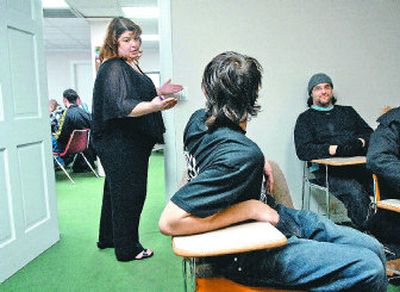

Staying out of jail allowed Jessica Roman to pursue a job.
Roman, 26, who was found guilty of negligent driving, was allowed to spend her five-day jail sentence in a new day reporting program instead of behind bars.
Had Roman gone to jail, she said she would have lost her apartment. Instead, she created a resume and began applying for jobs.
“I would have gone five steps backwards instead of 10 steps forward,” Roman said.
Stories like Roman’s and a continued crunch on jail space were enough to convince Spokane County commissioners to continue funding a day reporting option for nonviolent offenders even though they had hoped the program would no longer need tax subsidies by now. The program is run by Friendship Diversion Services, an Olympia-based nonprofit agency that provides alternative jail programs in eight Washington counties.
Offenders sent to day reporting must account for eight hours daily Monday through Friday for each day of their sentences. If they are employed, work counts. If not, they spend time looking for a job, going to treatment such as Alcoholics Anonymous or attending job training. Program employees assist the offenders in finding job and training opportunities.
In 2006, the first year of the program, 297 defendants were sent to day reporting in Spokane County. Of those, 72 got a job as a result of their efforts while in the program, according to statistics given to the county by Friendship. Another 22 who already were employed found better work.
Participants are charged up to $20 a day, depending on what they can afford.
County commissioners approved the idea at the beginning of last year and allocated $30,000 to the program to get it going. Day-reporting officials received an additional $10,000 a month from commissioners for the last seven months of 2006. County official said they hoped it wouldn’t still need tax funds by now.
“That’s the way it was sold anyway,” said county CEO Marshall Farnell. Barbara Miller, executive director of Friendship Diversion Services, said she told leaders it was a goal to be self-supporting within two years, but she never promised that they wouldn’t need additional money.
Commissioner Mark Richard said he was disappointed the program hasn’t yet met the original hope of paying for itself, but noted that the program is much cheaper than keeping offenders behind bars. The county pays about $60 a day for each inmate it houses at Geiger Corrections Center.
“In my opinion it is self-sufficient because we’re spending less on these individuals than we were yesterday,” Richard said last week.
Richard also stressed that enough money is being raised from offenders to lower the county’s monthly subsidy to $5,000. He said he’s hopeful the city of Spokane will join the program so that with more offenders, day-reporting could be less dependent on tax dollars.
Spokane County never considered other firms to do day-reporting. County rules suggest, but don’t require, service contracts be put out to bid. Spokane County District Court Judge Sara Derr said the county used Friendship because the agency already was working in Spokane County on a different alternative sentencing program, and it was unlikely another firm would have been interested.
City of Spokane Prosecutor Howard Delaney said city rules prevent Spokane from signing up for Friendship’s program without holding a competitive bid process. He said the city doesn’t want to create a contract until leaders formulate a strategy for using alternatives to jail.
Last week, several local leaders including Delaney gathered to discuss day-reporting and similar ideas. Delaney said he’s hopeful the county, Spokane and other cities can create a uniform plan that would be on a larger scale and cost less. Having one contract could save even more, he said, if it included other alternative options, such as electronic home monitoring.
Even if other local governments can’t come to an agreement, Spokane likely will pursue a day-reporting program soon, Delaney said.
“It’s really an effort to efficiently and effectively improve public safety,” Delaney said.