
Celebrating George
MOUNT VERNON, Va. – For a century and more, it was about the house.
“It kind of evolved into a decorative arts tour,” says a Mount Vernon spokeswoman – wallpaper and bed linens.
And George Washington?
The man of whom historian Peter Henriques wrote: “If ever a man deserved secular immortality and eternal remembrance from a grateful nation, that man was George Washington”?
Well, we were left with the white-mopped guy on the dollar bill whose grim lips hid wooden teeth and who slept – beside the largely anonymous Martha – in the house when he wasn’t busy fathering a country.
The unkindest cut: “Washington’s Birthday” as a holiday disappeared and in 1971 was merged with Lincoln’s once-celebrated birthday into “Presidents’ Day” – thus lumping greatness with the likes of Franklin Pierce.
While George Washington withered into something between a caricature and a punch line, Mount Vernon became the weakest link in a high school spring-break experience that included the Capitol, the White House, the Air and Space Museum and hotel pillow fights.
But what’s officially called “George Washington’s Mount Vernon Estate and Gardens” last fall unveiled a major change of mission. They haven’t changed the name, but here’s a suggestion:
“The George Washington Show, Starring George Washington, With Wife Martha, the United States of America and Its Predecessor Identities, Assorted Slaves and Redcoats and Special Guest Star – Mount Vernon, the House.”
In other words, it’s not about chintz anymore. It’s about George – just in time for his 275th birthday on Thursday.
It’s about movie theaters with chairs that rrrrummble.
And it’s about the teeth – which, by the way, were not wooden. They’re tooth, mostly animal.
“They’re pretty amazing too,” says Jim Rees, Mount Vernon executive director, “because you can’t imagine putting them in your mouth and wearing them.”
They’re on display in their own gallery, “like the Hope Diamond,” notes spokeswoman Stephanie Brown.
Other stuff here to be seen and pondered: a sword, wine cups, clothing, buttons, manuscripts, snuff boxes – all the genuine articles, most of which have been stashed away in private collections and Mount Vernon storage for just about ever.
Everyone knows Lincoln. Composer Aaron Copland serenaded him in a musical portrait, Raymond Massey parlayed him into a career, schoolchildren presumably still recite his Gettysburg speech, and there may be no more inspiring work of art in this country than the capital’s Lincoln Memorial, especially at night.
Washington, by contrast, remains an expressionless dandy with a white wig (he didn’t wear one, by the way – it just looks like one).
His image is one of perfection, which doesn’t lend itself to speculation or screenplays. He never told a lie. His troops seem to have loved him. He was elected to the presidency twice by unanimous vote – and there were no charges of tinkering.
There was no scandal, personal or otherwise. He lived well. He paid his taxes. He died at home, at 67, in bed, of natural causes.
Now the birthday is gone, the portraits are rarely seen in classrooms, even the dollar bill is under attack by coin fans – and history in schools isn’t what it used to be, says Rees, in part because mandated tests emphasize other things.
“The kid coming today doesn’t know George Washington enough to appreciate the mansion, much less all the other things around the mansion,” he says.
Responding to that challenge, Rees and his design team have revolutionized the Mount Vernon Experience.
It has become a very different place than you might remember, no longer just a house and gift shop. If a kid doesn’t come out of here knowing George Washington, he should forfeit his iPod forever.
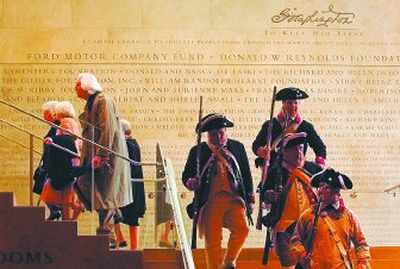
New is the Ford Orientation Center, courtesy of the car company fund. Greeting visitors are bronze sculptures of George, Martha and the two grandchildren they raised at Mount Vernon after the death of Martha’s son from a previous marriage – and how’s that for an opening salvo of stuff you never knew?
With the help of a new film, visitors will be introduced to George Washington the Human Being. And that’s a theme that carries right through the next series of theaters and galleries in the – again, new – Donald W. Reynolds Museum and Education Center, courtesy of the late media entrepreneur’s fund.
“He’s a really complex, fascinating person,” says Rees, “one of those rare people who kind of gets better the more you know.”
We learn the Father of Our Country was one of the best dancers around. He was an expert horseman. He owned and operated the country’s largest distillery. He introduced the mule to American farming.
He was 6-foot-2 at a time when most everybody else wasn’t (John Adams was 5-foot-7.) His battle experiences, inflated by the media, made him world-famous in his mid-20s.
He wasn’t perfect. Troops in his command as a British officer were defeated by the French at Fort Necessity just before the French and Indian War. (An actual piece of the fort is on display in the museum.)
You will not see a Dancing George, but there are magical things here – such as the 1785 bust of Washington by Frenchman Antoine Houdon, based on a life mask, universally considered the most accurate likeness.
Using modern forensics and whatever physical evidence exists (including clothing and those miserable teeth), scientists and artists also have created wax George Washingtons at ages 19, 45 (on horseback) and 57, being sworn in as president.
There are five, count ‘em, five movie theaters.
“We take you through (the battles at Boston, Trenton and Yorktown) through the use of multiple projectors,” says spokeswoman Brown. “When the cannons roar, the seats rumble. When you’re crossing the Delaware River, the snow will fall on you …”
This comes largely from the imagination of one Dennis Earl Moore, whose production company brought us such IMAX wonders as “Flyers” and “Living Planet.”
“We tried to get it as accurate as we can, but the 18th century is highly interpretive,” Moore says. “You could put five historians in a room and they might have a slightly different version – but I think (Rees) and everyone made an intense effort to get all those views and distill them.”
Adding an exposition center to grounds that hadn’t changed much in more than a century wasn’t a slam-dunk. Once funding was procured (more than $100 million, none of it government money), there still were fears about the impact of diddling with the integrity of the property.
“A year and a half ago, when people were just seeing a hole, they were concerned about that,” concedes Rees.
What they couldn’t see is that the hole would contain much of the new structure; except for the entryway and some other points of access, much of the construction is underground, covered by pasture that will be home to sheep.
“Even the square footage that’s above ground is tucked low behind trees,” Rees says. “That concern has not evaporated, but it has certainly lessened to a tremendous degree.
“I hope the person who remembers everything fondly from 40 years ago will think we certainly have done no harm to anything they enjoyed 40 years ago.”
The house still rules the land and still looks terrific. The dining room where the siege of Yorktown was planned, where Washington learned of his first election to the presidency and where he lay in state, is as it was.
The key to the Bastille – a gift from his friend Lafayette – is still in the foyer. The bedrooms – yes, Washington slept here – are as he would remember them. The view across the Potomac from the porch is as graceful and green as it was 2 1/2 centuries ago.
To those who worry about the Disneyfication of Mount Vernon, they needn’t. Call it tasteful recognition of reality.
“Even scholars,” says Rees, “the ones who 10 years ago would’ve called this sacrilege, many of them have come around to the understanding that an eighth-grade boy learns in a certain way that’s not the same as the biography they’re writing.
“They’ve said, ‘All power to you. Nothing else seems to be working, so good luck.’ “
It was drizzling during this visit. George Washington, in full finery, took cover beneath a museum overhang.
“I had to stop here to meet Gen. Rochambeau to final out the plans for the siege at Yorktown,” said the costumed interpreter, explaining his presence on the grounds.
His horse? “Down by the stable. You know, I circumnavigate my farm every day.”
But the new buildings, General. Certainly, you see …
“I’ll tell you one thing, sir. There is always construction going on here on our farm. We are doing our best to make things decent to the eye but as practical as possible.”
He’d be OK with this. No lie.
He deserved it.