
British undercut White House
WASHINGTON – As the British announced Wednesday the beginning of their departure from Iraq, President Bush’s top foreign policy aide proclaimed it “basically a good-news story.” Yet for an already-besieged White House, the British decision was doing a good job masquerading as a bad news story.
What National Security Adviser Stephen Hadley meant was that the British believe they have made enough progress in southern Iraq to turn over more of their sector to Iraqi forces. To many back in Washington, though, what resonated was that Bush’s main partner in Iraq is starting to get out just as the president is sending in more U.S. troops.
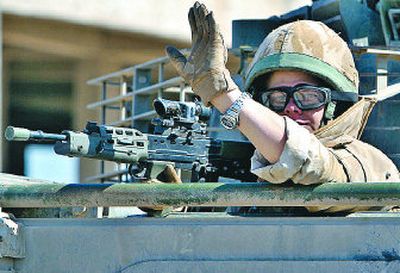
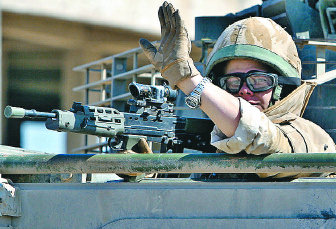
Prime Minister Tony Blair announced Wednesday that 1,600 British troops would return home from Iraq in the coming months, and a further 500 soldiers may be withdrawn by the end of summer.
Even though Britain has only 7,100 troops in Iraq compared with the 135,000-strong U.S. contingent, they carry symbolic importance as the largest allied presence. British forces make up half of the 14,000 non-U.S. troops in the coalition in Iraq.
No matter the military merits, the British move, followed by a similar announcement by Denmark, roiled the political debate in Washington at perhaps the worst moment for the White House. Democrats seized on them as evidence that Bush’s international coalition is collapsing and that the United States is increasingly alone in a losing cause. Even some Republicans and, in private, White House aides agreed the announcement sent an ill-timed message to the American public.
“What I’m worried about is that the American public will be quite perplexed by the president adding forces while our principal ally is subtracting forces,” said Sen. John Warner, R-Va., a longtime war supporter who opposes Bush’s troop increase. “That is the burden we are being left with here.”
The notion that the British pullback actually signals success sounds like bad spin, added Sen. Arlen Specter, R-Pa. “I think it’s Alice in Wonderland looking through the looking glass,” he said.
White House officials said they had known for a while that the British were moving in this direction and that Prime Minister Tony Blair informed Bush of his decision during a secure videoconference Tuesday. But the rest of Washington was taken by surprise and Republicans were put back on their heels, just as they were beginning to feel more confident that the fight over war strategy was shifting their way.
The House last week approved a nonbinding resolution opposing the president’s planned deployment of 21,500 additional troops to Baghdad and Anbar province in western Iraq. But Republicans have been on offense since then, hammering a House Democratic plan that would tie war funding in a supplemental spending bill to strict new standards for resting, equipping and training troops.
The strategy, championed by Rep. John Murtha, D-Pa., and endorsed in principle by House Speaker Nancy Pelosi, D-Calif., was supposed to neutralize GOP charges that Democrats planned to “de-fund” the war, while forcing Republicans to defend the deployment of troops who are not rated fully trained and equipped. But Republicans labeled it a “slow-bleed” strategy that would leave troops in harm’s way by blocking their reinforcements.
The news of Britain’s partial withdrawal, though, swamped the funding debate for at least a day. “The timing of the British announcement is very unfortunate,” said Nile Gardiner, a scholar at the conservative Heritage Foundation. “The British decision is going to be used as a political football by opponents of the president’s Iraq plan.”
Rep. Ray LaHood, R-Ill., said the move will undercut Republicans in Congress trying to stave off attempts to tie Bush’s hands in Iraq.
“It’s probably not going to bode well for those of us who want to make a case against what Murtha and Pelosi plan for the supplemental,” LaHood said. “It does not help.”
Blair’s announcement could also boost calls by Democrats and some Republicans for a serious change in Iraq policy – not just in the number of troops fighting but also in what those troops should be doing. The British plan to withdraw 2,100 of 7,100 troops by summer’s end and to redeploy the remainder away from combat toward more training of Iraqi troops and patrolling the Iranian border. That mirrors bipartisan Senate proposals for U.S. forces that are spelled out in two stalled nonbinding resolutions, including one co-sponsored by Warner.
“What the British are doing, and what we really need to do, is to tease out the cultural complexities of this thing,” said Rep. Wayne Gilchrest, R-Md. “On the one hand, they are signaling to all the Iraqi people, whatever sect they are, Sunnis, Shias, Kurds, they are not going to be an occupying force. That’s a powerful signal to send. And the other signal is that they are passing the torch to the Iraqis, who are the only ones who can handle this ancient, I’d say primitive, sectarian dispute.”
The White House argued that comparing the British situation in Basra and the U.S. position in Baghdad fundamentally distorts reality. The south, where the British have been in charge, has no Sunni insurgency and far less violence than Baghdad or Anbar. The coalition plan all along has been to pull out foreign troops when an area is ready for Iraqi control, the White House said.
“The fact that they have made some progress on the ground is going to enable them to move some of the forces out, and that’s ultimately the kind of thing that we want to be able to see throughout Iraq,” said White House press secretary Tony Snow. He said no consideration was given to asking the British to instead redeploy those departing troops to help their U.S. counterparts in Baghdad or Anbar.
The British drawdown follows withdrawals by other members of Bush’s “coalition of the willing.” Long gone are troops from Spain and Italy, whose leaders were booted out of office by voters unhappy with their war alliances with Bush.
Denmark recently said it would withdraw all its 460 troops by August. South Korea, which now has 2,300 in the northern Iraqi city of Irbil, plans to bring 1,100 home by April, and its parliament insists on a complete withdrawal by the end of 2007.
Secretary of State Condoleezza Rice said the British pullback squares with the U.S. plan to turn over more control to Iraqis. “The coalition remains intact and, in fact, the British still have thousands of troops deployed in Iraq,” she said.
The Pentagon has stopped publicly listing the countries in the coalition and troop levels.
In a recent count by the Associated Press that includes information from individual coalition partners, 22 countries still have forces in Iraq. Only Britain and South Korea are contributing more than 1,000 each.