
Moose habits tracked in favored spot
ANACONDA, Mont. – Vanna Boccadori scans the thick willows from a commanding view in a helicopter high above, trying to spot moose.
The distinctive, black shape of a cow moose stands out in the willows just off the Mill Creek Highway on the Mount Haggin Wildlife Management Area, south of Anaconda. Then another moose comes into view. And yet another.
“It’s like an Easter egg hunt,” Boccadori, Butte biologist with the Montana Department of Fish, Wildlife and Parks, said later Tuesday after completing a day of tagging and collaring moose for a study.
Once Boccadori and department veterinarian Mark Atkinson mark their targets, pilot Mark Duffey swoops down to within feet of the unsuspecting moose. It runs from the sound and the flurry of snow that’s kicked up, but it’s too late.
Atkinson darts the cow, then the helicopter lifts off to give the drug time to take effect.
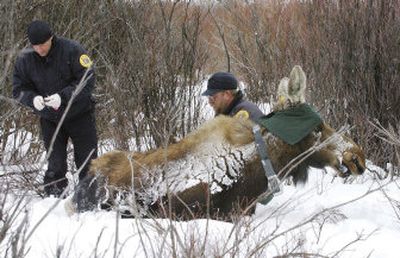
When the moose lies down, the crew moves in to blindfold it, collect some samples and attach a collar that will track its location for the next year.
They work fast, with a 10-minute target to get everything done and get the moose back on its feet.
Atkinson said they use an opioid that doesn’t put out a moose completely so it can quickly recover.
“We don’t want to have them down too long, because we’re not doing anything too invasive,” he said. “We’ve found a drug that’s safe. It’s effective, and it gets them down quickly.”
The six cows collared are central to a study Boccadori is conducting on moose habits and movements on the Mount Haggin area.
The Mill Creek Highway is dubbed “moose alley” by local residents and for good reason. On a typical winter day, more than half a dozen can often be spotted from the highway.
Moose like the area because it’s textbook habitat for them with plenty of willows.
But the west half of Mount Haggin is open to skiers and snowmobilers, unlike other game management areas in the state. Boccadori’s study aims to learn which areas the moose prefer at different times of the year.
The information on the animals’ habits will be coupled with a survey Fish, Wildlife and Parks officials are conducting on snowmobile and cross country ski use on Mount Haggin. Workers are taking counts of both uses to discern how heavily the area gets used in winter.
Ultimately, the information will be used to better manage the area’s skiing and snowmobiling so it doesn’t disrupt the moose too much, Boccadori said.
State officials have no plans to close the area in winter, but some areas could be put off limits if heavy use stresses the moose.
“It will help us to better manage winter recreation in the context that this is moose winter range,” she said. “It might end up that we’re steering people around certain areas.”
The study will also be used to manage the moose population, including setting season types and quotas.
Cow moose are used because females are indicative of a population, Boccadori said.
Three of the cows had calves with them that were not collared.
“It’s a very potent narcotic that we use,” Atkinson said. “If we used that same amount in that same drug with an elk it would knock it on its side, but with a moose it’s an entirely different reaction.”
When a moose is down, a blindfold is placed over its eyes. Then Atkinson gets blood and fecal samples while the collar is placed around its neck and tags are put in its ears.
The collars are a high-tech piece of equipment that contain a Global Positioning System and a transmitter that emits a signal. The GPS will track the moose’s location every four hours for the next year.
At that time, a small explosive device will go off and drop the collar.
Its transmitter will allow biologists to retrieve it to store the data and then refurbish it for another use.
After all the work is done, the blinders are removed from the animal. All the moose stand up, confused and sporting new neckwear, but unharmed before dashing off from the helicopter as it lifted the crew away.
Atkinson said the six cows they tagged that day were in good health.
Their bodies had strong fat reserves, they had healthy teeth and coats, and they weren’t infected with parasites.
The samples will be used for additional health tests, including for pregnancy, overall blood chemistry and diseases.
And the ear tags were added so biologists can again tag the moose next year to continue the study, Boccadori said.
Moose are fairly consistent in their habits, which should make it possible to keep the project going.
“I’d be surprised if we didn’t find the same ones next year,” she said.