
Town isn’t out of the woods
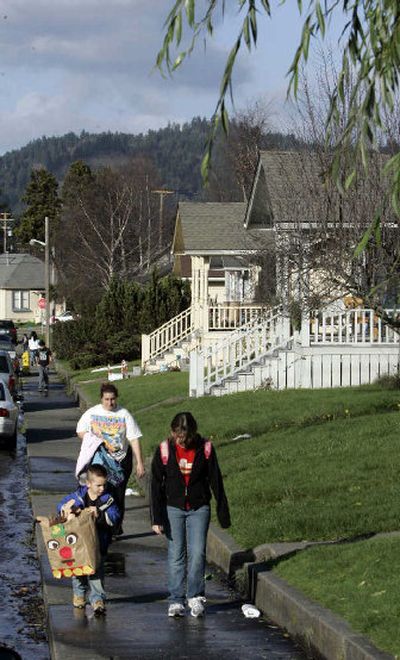

SCOTIA, Calif. — Along with the scent of freshly cut redwood, an air of uncertainty hangs over this idyllic Northern California logging town.
Mel Berti feels it from behind the butcher counter at Hoby’s Market, where he has greeted lumber mill workers and their families by name for three decades.
Nodding toward the tidy streets and rows of whitewashed bungalows outside, he wonders what the Scotia he knows will look like in another 10 years — now that its days as a company town, one of the last in America, are numbered.
“It’s not getting any better than it is now, I’ll tell you that,” said Berti, 67. “There’s not a town around that looks this nice while being maintained as a regular town.”
After 141 years as Scotia’s only employer, landlord and property manager, Pacific Lumber Co. is getting out of the real estate business. Citing declining timber prices and a need to raise cash, its Houston-based parent company, Maxxam Inc., plans to sell Scotia’s 270 homes, stores, pair of churches, hotel, museum, movie theater and recreation center in 2007.
PalCo, as the company is known, hopes the rest of its holdings 137 miles south of the Oregon-California border — from the fire department and street lights to the power plant and sewer system — will be annexed and governed by the adjoining town of Rio Dell — a community as scruffy as Scotia is spic-and-span.
For generations, employees of PalCo and the town’s auxiliary businesses have been Scotia’s only residents, and the company is pitching its divestment as an economic opportunity for them. They will be offered first dibs on buying the homes they now rent at subsidized rates ranging from $500 to $700 a month.
“There is a continuity here the people like, and we want to maintain that,” said Dennis E. Wood, Pacific Lumber’s vice president for strategic planning.
Yet gazing a quarter-mile across the green-girdered bridge that spans the Eel River and separates Scotia from Rio Dell, makes some of Scotia’s 800 residents nervous about their future as free agents.
In all, PalCo spends about $1 million a year landscaping yards, sponsoring community events and performing other tasks that protect Scotia’s pristine, 19th century ambiance. Rio Dell’s boarded up storefronts and uneven housing stock offer an unsettling vision of what could become of Scotia without the company’s patronage.
“I compare it to a fire — you never know what’s going to happen, you just deal with it,” said John Broadstock, an 18-year resident and chief of the volunteer fire department.
Further fueling the apprehension are doubts about long-term prospects for timber, the main employer in California’s thinly populated upper reaches.
PalCo is the state’s largest private owner of old-growth redwood forest. But in the decade since activist Julia Butterfly Hill drew attention to its logging practices by spending more than two years perched in an ancient tree, environmental protests and regulations have made fewer of its 210,000 acres available for logging.
In the last five years, the company has closed two mills, repeatedly threatened bankruptcy and laid off hundreds of employees. Some worry whether selling Scotia signals PalCo is preparing to leave town altogether, making buying a house there a risky investment.
“It’s at the point here where the people don’t know if they will have a job next week or not,” said Berti, who like many old-timers speaks nostalgically of the days before the family that owned PalCo sold it to Maxxam in 1987.
It’s too soon to say what the two- and three-bedroom houses will sell for, but Wood said he expects it to be less than Humboldt County’s median price of $300,000. Besides the novelty of taking on a mortgage, residents who end up buying the homes — a survey PalCo conducted earlier in the year showed that upward of 75 percent said they would like to — would have to pay for garbage pickup, water and sewer service, costs the company always covered.