
Diplomats push for Somalia peacekeepers
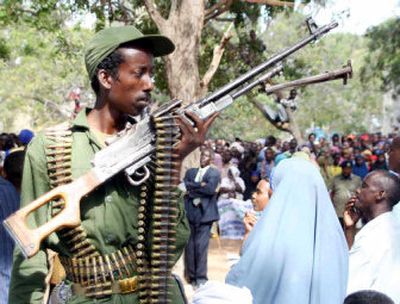
WASHINGTON – Rapidly unfolding events in Somalia have opened a window of opportunity to establish a viable government there, according to the Bush administration and its European and African allies. But there is little optimism that the international political will and resources needed to exploit it will emerge before the window slams shut.
Diplomats from the United States and from other nations in the Somalia Contact Group are meeting today in Brussels to examine options for quickly installing an all-African peacekeeping force. The Africans would replace Ethiopian troops whose lightning invasion ousted Islamic fundamentalist forces last week from Mogadishu. Also under discussion is an effort to persuade cooperative elements of the newly ensconced Transitional Federal Government to open unity talks with certain moderate leaders of the Islamic fundamentalist forces that have now been driven from southern Somalia.
The contact group – which includes U.S., European and African participation – has discussed African peacekeepers and a unity government for some time with little progress. Today’s meeting of the six-month-old group opens with new urgency for movement.
“The situation on the ground has changed dramatically, possibly for the better,” said a European diplomat whose government is closely involved in the issue and who insisted on anonymity when discussing the sensitive negotiations. “The name of the game is how to make sure that the government establishes itself” to survive without Ethiopian military occupation. “Somalis don’t like the idea of Ethiopian troops manning the capital.”
“On the other hand, if the Ethiopians withdraw all of a sudden,” he said, “what’s going to happen? There’s a fine balance between maintaining and consolidating the government” and allowing feuding warlords on all sides of Somalia’s political divides to reactivate their militias.
Ethiopian Prime Minister Meles Zenawi said Tuesday that his troops would stay “for a few weeks” but called on “the international community to deploy a peacekeeping force in Somalia without delay to avoid a vacuum and the resurgence of extremists and terrorists.”
The Bush administration also sees the current upheaval as an opportunity to capture three senior al-Qaida operatives it says have been sheltered by a faction of the Somali Islamists. U.S. Navy ships have been dispatched from the Central Command installation in neighboring Djibouti to patrol the East African coastline for a possible escape as the Islamists and their militias have been pushed south to the Kenya border. A senior U.S. counterterrorism official said he had seen no intelligence evidence to support earlier reports that legions of foreign fighters had landed last week in Mogadishu to support the Islamists.
A plan to send African peacekeepers, approved last month by the African Union and the U.N. Security Council, has foundered on a lack of volunteers and the resources to support them. “I wish I could be optimistic, but Somalia is tough and everybody in the neighborhood knows it’s tough,” said the counterterrorism official.