
Bill Gates-backed company delivers its first microjet
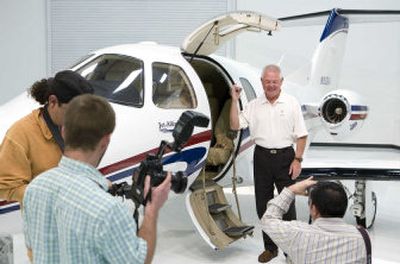

ALBUQUERQUE, N.M. – Eclipse Aviation has made a major voyage with a very small jet.
The company, run by a former Microsoft executive and backed by Bill Gates, has become the second in the U.S to deliver one of the new planes, known as microjets, “very light jets,” or VLJs, which are expected to fill the skies over the next decade. They generally have two engines, five or six passenger seats and automated cockpits; they cost half as much as the most inexpensive business jet now in service.
Eclipse President Vern Raburn on Thursday handed keys to the first customer-ordered Eclipse 500 to Jet-Alliance Chairman Randall Sanada and David Crowe, an owner-pilot who purchased a share of the aircraft.
“This aircraft represents the end of the development era for Eclipse,” Raburn said during a ceremony inside an Eclipse hangar. “We are now a company. We have a transaction. We give Dave an invoice and Dave gives us money.”
Thursday’s delivery was a significant milestone after a bumpy year in which the 9-year-old manufacturer endured a lengthy federal certification process.
Only privately owned Eclipse Aviation, whose second-largest investor is Microsoft Corp. Chairman Bill Gates, and Cessna Aircraft Co., a unit of Textron Inc., have received Federal Aviation Administration certification for the jets so far. Cessna delivered its first in November.
Crowe kissed the keys to the white aircraft, trimmed in burgundy and blue with a tan leather interior, after taking them from Raburn. “Ain’t she a beaut?” Sanada said.
The Eclipse 500, dubbed the SUV of the skies, currently lists at $1.5 million. Raburn said the company hopes to deliver 500 planes to customers this year.
There currently are 39 planes on the production line at the Albuquerque manufacturing facility, with five ready for customer delivery after the FAA certifies each individual aircraft, Eclipse officials said.
Sanada predicted the Eclipse 500 will change the way people travel, making it more affordable for small businesses or private owners to have aircraft and for air-taxi firms to ferry passengers.
VLJs can land on runways as short as 3,000 feet, compared to the 4,000 or 5,000 feet required by the smallest jets now being flown. The FAA says there are more than 5,000 small, underused airports in the United States. The National Business Aviation Association defines VLJs as single-pilot jets that weigh 10,000 pounds or less.
Crowe already has flown the airplane and called it the easiest one he ever piloted. He praised its stability during flight and higher flight ceiling compared to piston-driven or turboprop private airplanes.
He also loves the side-stick control, similar to a joystick on a military fighter jet or a television game console. Crowe said it gives the pilot a better sight line to avionics gauges, which are partially obscured on yoke-controlled airplanes.
“There’s no interference for the panel,” Crowe said. “It’s more logical for the pilot. You get what you need right in front of you.”
Crowe is excited to play with his new toy.
“The fleet age of private aviation is ancient and the industry was due for an update,” Crowe said. “Now you can get an iPod instead of carrying your boom box around.”