
Handmade comfort
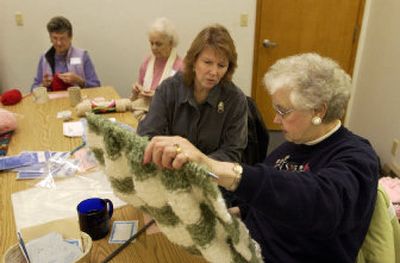
It’s 10:30 Monday morning as the women of St. Mary’s Catholic Parish trickle into a spare church conference room, each with a bag of yarn, primed for higher purpose.
The 10 women exchange pleasantries as their coffee cools, then cross themselves, bow their heads and get down to the business of prayer shawl ministry.
“We gather as a community to share our prayer, or stories, the work of our hearts and hands, we pray for God’s blessing on our endeavors:
Bless our minds to be free of any negative feelings or thoughts.
Bless our hands to be the source of creating something of beauty and love.
Bless our soul to be open to the promptings of loving and caring.
Bless our yarn to be shaped into patterns of beauty.
Bless our needles and hooks to be the creators of lovely shawls.
Bless our knitting and crocheting to be a work of heart, hands, body and spirit.
Bless the one who will receive the fruit of our prayers and our knitting and crocheting.
May this shawl be welcomed in the spirit in which it was made.
May we become one with the One who knit each of us in our mother’s womb.
We join our prayers, our knitting and our crocheting with women all over the earth in this common effort to bring healing and wholeness, comfort and love.
In the name of the Father, Son and Holy Spirit, Amen.
Prayer shawl ministry is a nondenominational phenomenon sparked by two Hartford, Conn., seminarians. Janet Bristow and Victoria Galo created the knitting project while taking a course in applied feminist spirituality at the Women’s Leadership Institute. Finished shawls are given to people in the throes of death, grief or illness.
The St. Mary’s knitters give their shawls to Hospice of Spokane, or anyone they know of in need of spiritual assurance and comfort. Each shawl is blessed by a priest before it’s given away.
Churches have taken up the prayer shawl cause, inspired by meaningful testimonies and the Web site www.shawlministry.com. The homespun happening has no unifying name or dues, and just a few simple guidelines.
The ground rules for the St. Mary’s group are simple, start with a pre-knitting prayer and blessings for the recipient, then carry those thoughts forward while making the shawl. The rules are easier said than done.
A prayer shawl knitted during a Gonzaga University basketball game might not be free of any negative feelings or thoughts, said Naomi Robinson. Some of the women use a stitch that’s knit one, pearl three, allowing them to cite the Holy Trinity in progression over each pearl, though any knitting style or pattern will do.
“We pray for them with every stitch,” said Maggie Albo, a knitter and chaplain for Hospice of Spokane.
It was Albo who brought the knitting concept to St. Mary’s. She experienced the prayer shawl’s power firsthand when her former hospice supervisor Episcopal Rev. Katherine Cooper died in 2004.
“I was really having a hard time with it, and then somebody gave me a prayer shawl,” said Albo. “I said, ‘This is good. I’ll pray with this,’ but it’s been so much more.”
Hospice deals with patients believed to be within six months of death. Albo and other hospice employees work with the dying to make sure they’re prepared for life’s last step and help family members with the loss.
Often clients are in awe to learn that a stranger has knitted them a shawl and prayed over every stitch. The shawls are presented with a small card disclosing the first name of the knitter and explaining the gift’s intent. The shawl also comes with a prayer:
“In happy times, praise God.
In difficult times, seek God
In quiet moments, worship God.
In painful moments, trust God.
Every moment, thank God.”
Albo has seen grown men wrap themselves in the knitted throws and rarely remove the gifts until life’s end. The knitters hold their arms out wide and measure wrist to wrist to get the correct measurement for a comfortable size.
Cancer patients bundle up in the shawls to ease the endless chill of chemotherapy. In many cases, the shawls are placed in caskets when their warmth is no longer needed. At least one other group knits prayer shawls. Oncology patients at Sacred Heart Medical Center receive shawls from the First Assembly of God Church.
At St. Mary’s, as the knitting circle’s discussion turns to shawl candidates, nearly every woman at the table mentions someone deserving. Bess Routt suggests an in-law with health problems in the Southwest. Alma Belisle names an older St. Mary’s parishioner and no sooner does she get out the words when another knitter mentions that the parishioner’s wife also is not doing well.
Two shawls could be in order, the women agreed. In the quiet crush of knotted yarn and clicking needles, they moved on.