
Casey Sargent inspired by classic works
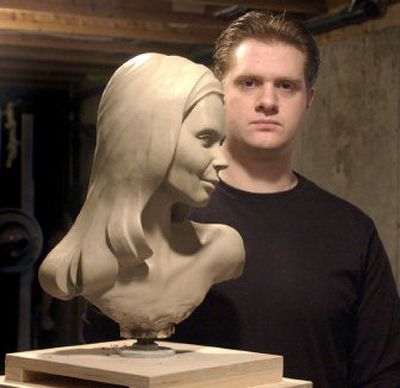

Artist Casey Sargent’s bronzes are timeless, capturing the essence of humans and animals in midmovement or thought.
About a dozen such pieces reside in the basement studio of Sargent’s Valley home, where he forms and carves his creations out of wax or clay. Eventually they will be taken to a foundry to become bronze masterpieces.
Sargent, 26, is a traditional artist with a style reminiscent of the old masters and, like Leonardo da Vinci, he is fascinated with the human form. Posters of the human skeletal and muscular systems are displayed above his work table for reference.
“One reason I like to sculpt, draw or paint the human form is because there is a lot to learn,” Sargent said. “It is very challenging because of the complexity of the human body, plus everyone knows what a person should look like. Animals are also complex and I love to figure out what makes them work. More importantly is how to put a soul or a spirit into the piece of art.”
Sargent has learned his craft by doing. In elementary school, he stayed in during recess to draw. In junior high, he stayed after school to work on art projects. And in wood shop, his teacher let him carve wood while others were building birdhouses. His older sister played softball and the father of one of her teammates encouraged Sargent to whittle.
“He would whittle during the games,” Sargent said. “I began doing the same. He took an interest in me and cut out wood blanks for me to carve. It was an early introduction to sculpting.”
Sargent attended Spokane Falls Community College, where he studied graphic design and learned to paint using a computer program. He also took a sculpting class from local sculptor Ken Spiering. Later, an internship led Sargent to North by Northwest Productions, where he has since worked on nine films doing murals, paintings and computer work. His list of credits include “Mozart and the Whale,” “Home of the Brave,” and “End Game.”
Sargent is a freelance artist and has done airbrushing, painting, sculpting and graphic design work for a host of clients. He has picked up skills from other artists along the way.
“I get more out of watching artists work than them telling me how to do it,” he said.
Sargent is a quiet and patient artist. He watches and studies his environment, meticulously recreating his findings.
“When I see things, I look at it in a couple of perspectives,” he said, “I notice the technical side of things, like how color might bounce off one object onto another or how muscle and bone affect the outer form. Then there is the other side and how these things affect mood.”
Sargent wants his work to speak for itself and hopes that when people look at his work, they imagine movement. He takes an old-fashioned approach to his creations; his classical studies are grounded in a strong foundation of learning and doing.
“I would like for people to think of the old masters when they look at my work,” he said.
Currently, Sargent is working with another artist on a large bulldog sculpture for Gonzaga University. His goal is to buy a piece of land and build a working studio, where he will live and breathe art full time, and where he will create timeless art that lives and breathes.