
Healthy competition
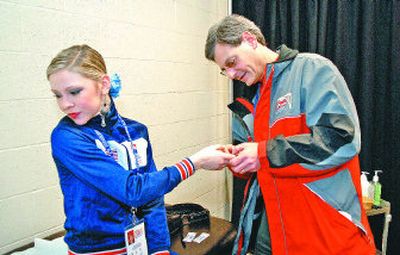
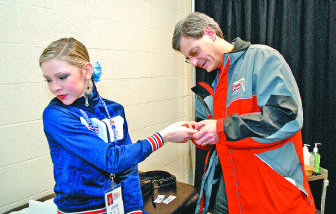
It’s not even 8 a.m. Tuesday and Dr. Ed Reisman – who got about five hours of sleep the night before – is stitching up an injured figure skater at the Convention Center.
The gash on the skater’s right middle finger, slashed by a skate blade, runs pretty deep. But it’s Reisman’s goal to get her stitched, bandaged and back on the ice as soon as possible.
“These people don’t want to hear the message, ‘Stop and rest,’ ” he said.
Reisman, a Group Health doctor on Spokane’s North Side, is coordinating medical care for the skaters, coaches and officials during the 2007 State Farm U.S. Figure Skating Championships. He’s been a family practice doctor for more than 20 years, as well as as a team doctor for professional and college athletics.
But when it comes to ice skating, Reisman, who turns 49 today, brings a special perspective to the job.
The doctor himself was a successful competitive skater some 30 years ago and even placed second, along with his sister, in junior pairs at nationals in 1976.
And that’s part of the reason he knows how important it is to get an injured skater back out on the ice, if it’s medically feasible.
“The national championships is like the pinnacle for the vast majority of skaters competing,” he said. “This is as far as they can go.”
Reisman grew up in Southern California and got hooked on skating when he was about 12 after visiting a rink at a shopping mall. He started skating that summer, and by the fall he wanted more lessons. His younger sisters took up the sport too.
Soon, he’d be skating three hours a day, six days a week for the next seven years.
Legendary coach Frank Carroll trained skaters at the same rink in Burbank, Calif., where Reisman skated as a teen. Now, the two bump into each other at competitions, just as they did Tuesday in the basement of the Spokane Arena.
Carroll said he appreciates calling on a doctor who also was a skater.
“He understands the strains and uses of the body unique to figure skating,” Carroll said. “We’ve done a lot of international trips together. It’s always good to be with a friend on these trips.”
Since 1992, Reisman has made at least one international trip each year at the request of U.S. Figure Skating to care for American skaters. He has traveled to South Korea, Hong Kong and Switzerland, among other places. In 2002, he served as medical director for the Skate America event in Spokane.
He has been on board to bring the nationals to Spokane since the city started lobbying to host the event, he said.
Now that it’s here, Reisman rarely slows down. He’s sleeping at the Doubletree Hotel all week to be nearer to the action. He’s a whisper away from the ice for every competition. On Monday, he watched an event until after 11 p.m., then he swung back to the Convention Center to attend to a skater who had a bruised muscle. It was close to midnight by the time he made it to his room, only to wake up a few hours later to be interviewed on a TV show.
On Tuesday, he grabbed a couple of saltines in desperation and called it a late breakfast.
Reisman runs the show when it comes to medical care at the nationals, but he has lots of helpers. At each venue there is always one doctor or physician assistant, a physical therapist, a certified athletic trainer and two student athletic trainers. A chiropractor and massage therapist are stationed at the Arena. And a doctor, nurse and physical therapist are on hand at the skaters’ hotel.
“I had plenty of volunteers,” Reisman said.
Dr. Tom Schaaf, medical director for Group Health clinics in Eastern Washington and North Idaho, has known Reisman since medical school. Schaaf is pitching in, working several shifts at skating events.
“He’s very passionate about skating and very knowledgeable about the medical layout of this,” Schaaf said.
Reisman is known for coming up with innovative solutions to problems, Schaaf said. Plus, he’s just a fun, down-to-earth guy who even brought his guitar to his hotel room at the Doubletree.
On Tuesday, Schaaf held a small light so Reisman could see as he sutured the crying skater’s manicured finger.
Later in the morning, Reisman talked with a skater who had bronchitis and exercise-induced asthma. He urged the young man to use his inhaler several times a day, get plenty of rest and drink lots of fluids.
So far, no skater has suffered a competition-ending injury, Reisman said, though there have been lots of bumps, bruises, cuts and over-use injuries. And he hopes it stays that way.
Nothing would make him happier than sitting rink-side, watching the skaters whirl and twirl by, and not having to rush onto the rink to treat any of them.
“The reality is, most of the time I’m just sitting by the ice and hoping nobody gets hurt,” he said.